AI estimate as of August 2, 2025 · verify with a professional before acting
AI-Generated · Verify before acting
Everything on this page is generated by AI for informational purposes only. AI can make mistakes — the AI may misidentify items or misattribute them (artist, maker, brand, designer, origin, era). This is not an official valuation and should not be used for insurance, sale, tax, estate, legal, or lending purposes — or any decision requiring a certified appraisal. It is not an authoritative claim about any person, brand, or rights holder — do not share or rely on it as a factual statement about a third party. Always consult qualified professionals before making financial decisions.
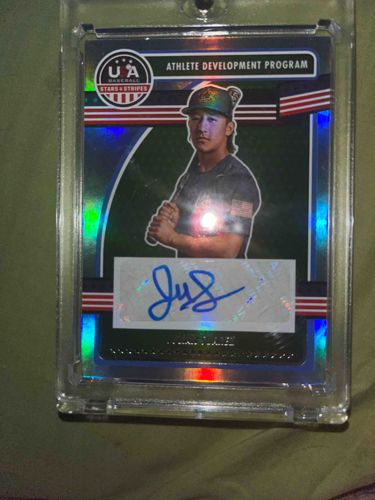
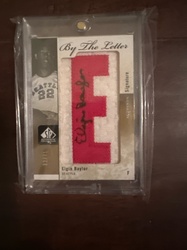
The item is a modern baseball trading card, specifically from the 'USA Baseball Stars & Stripes Athlete Development Program' series. It is encased in a clear, rigid plastic slab, commonly known as a 'one-touch' magnetic holder, designed for protection and display. The card itself features a prominent central image of a male athlete, shown from the chest up, holding a baseball bat. The athlete appears to be of Asian descent, wearing a cap with a multi-colored, possibly iridescent or holographic brim, and a dark shirt with an American flag patch on the sleeve. The background of the card is a combination of dark green and a prominent blue border, outlined by thin red and white stripes mirroring the American flag motif. The card exhibits a holographic or prismatic foil effect, particularly noticeable in the vertical blue strips on either side of the athlete's image and along the card's borders, which generate colorful reflections when light hits them. Above the athlete's image, there's a banner stating 'ATHLETE DEVELOPMENT PROGRAM'. To the left, a circular logo reads 'USA Baseball' with 'STARS & STRIPES' below it. A key feature of this card is the on-card autograph, which is prominently placed on a white rectangular patch below the athlete. The signature is in blue ink and appears to be 'JDS' in a flowing script. The card appears to be in excellent condition, with no visible wear, creasing, or damage to the card surface or edges, suggesting it has been well-preserved within its protective case. The clarity of the image, sharpness of the graphics, and vibrancy of colors indicate high-quality manufacturing. Given the 'Athlete Development Program' branding and the player's appearance, the card likely represents a prospect or a younger player associated with USA Baseball, placing its estimated age within the last decade or two.
AI Appraisal Report
I have thoroughly examined the provided image of this USA Baseball Stars & Stripes Athlete Development Program autographed trading card. Visually, the card appears to be in exceptional condition, likely near-mint to gem-mint, protected within its 'one-touch' magnetic holder. I observe no visible surface wear, corner dings, or creasing, and the holographic elements appear vibrant and intact. The on-card autograph in blue ink further enhances its appeal.
From a market perspective, autographed USA Baseball prospect cards from programs like "Stars & Stripes" hold value, particularly if the athlete goes on to have a successful professional career. The "Athlete Development Program" branding suggests this is a card of a promising young talent. The foil effects and design elements are consistent with modern, higher-end insert sets.
Demand for such cards is driven by collectors of specific players, team prospects, or those who collect USA Baseball memorabilia. Rarity is determined by the specific print run; without knowing if this is a numbered parallel (e.g., /99, /25), its exact rarity is difficult to ascertain from the image alone, although autographed cards are generally less common than base versions. The "JDS" signature is a significant factor in valuation, and its perceived authenticity from the image is high, characteristic of on-card autographs from official releases.
However, it's crucial to state the limitations of an image-based appraisal. While the card's condition appears excellent, only a physical inspection can confirm the absence of subtle surface imperfections (e.g., print lines, minor scratches) or edge wear not visible in the provided photo. Most importantly, definitive authentication of the autograph would require in-person examination by a reputable third-party authenticator like Beckett (BAS), PSA/DNA, or JSA. Obtaining a certificate of authenticity from such services would significantly enhance its market value and desirability. Without a confirmed identity for "JDS" and knowledge of their player status, the value remains somewhat speculative.
For a full authentication, I would require a physical examination to verify the card's surface, corners, and edges under magnification. Provenance documentation, such as where and when the autograph was obtained, would also be beneficial. Scientific testing, such as ink analysis, is not typically performed on modern trading card autographs unless serious doubt exists about authenticity.