AI estimate as of October 29, 2025 · verify with a professional before acting
AI-Generated · Verify before acting
Everything on this page is generated by AI for informational purposes only. AI can make mistakes — the AI may misidentify items or misattribute them (artist, maker, brand, designer, origin, era). This is not an official valuation and should not be used for insurance, sale, tax, estate, legal, or lending purposes — or any decision requiring a certified appraisal. It is not an authoritative claim about any person, brand, or rights holder — do not share or rely on it as a factual statement about a third party. Always consult qualified professionals before making financial decisions.
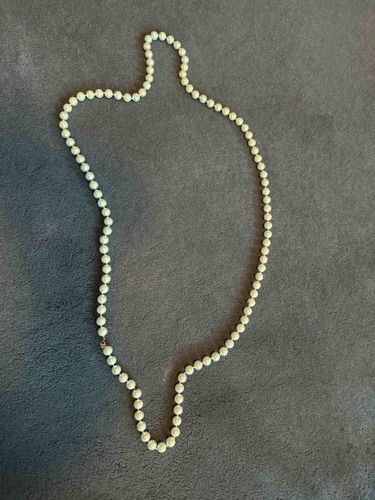
This item is a single strand necklace composed of numerous uniformly sized, spherical beads, likely pearls or faux pearls. The beads appear to be off-white or cream in color with a subtle luster, suggesting either natural pearls, cultured pearls, or high-quality imitation pearls. Each bead is individually strung and appears to be knotted in between, a common practice in pearl stringing to prevent loss of all beads if the strand breaks and to protect the pearls from rubbing against each other. The overall length of the necklace, as it lays on the grey, possibly felt or velvet surface, suggests it is a long 'opera' or 'rope' length necklace, designed to be worn long or potentially wrapped multiple times. There is a visible clasp or connector element on one side, which appears to be a small, possibly rose-gold or copper-toned metal component, indicating the necklace can be opened and closed. The construction appears sturdy, with no visible signs of broken stringing or loose beads. The beads display a consistent size and shape, indicating careful selection or manufacturing. There are no obvious chips, cracks, or discoloration on the visible beads, and the overall condition appears to be good with minimal wear. Without a closer inspection, it's difficult to ascertain specific manufacturing marks or the exact age, but the classic design suggests it could be from the mid-20th century to contemporary. The craftsmanship appears to be of decent quality, with the individual knotting being a key indicator of attention to detail and a certain standard of construction in beaded jewelry.
AI Appraisal Report
Based on my visual examination of the Single Strand Pearl Necklace, I estimate its appraisal value to be between $150 and $350. The necklace appears to be in good condition, with uniformly sized, spherical, off-white or cream-colored beads exhibiting a subtle luster. The individual knotting between each bead is a positive indicator of quality craftsmanship, enhancing durability and preventing loss of all beads if the strand breaks. The length suggests an 'opera' or 'rope' style, which is versatile and generally more valuable than shorter strands. The small, possibly rose-gold or copper-toned metal clasp appears functional. The consistent size, shape, and lack of visible chips or discoloration suggest careful selection or manufacturing.
Market conditions for vintage or classic-style pearl necklaces are generally stable, with demand varying based on the authenticity and quality of the pearls. Without direct handling, it is impossible to definitively determine if these are natural pearls, cultured pearls, or high-quality imitation pearls. True natural pearls of this size and uniformity would fetch a significantly higher value, while excellent faux pearls would be at the lower end of my estimated range.
Factors significantly impacting value include the actual material of the beads (determining authenticity as natural, cultured, or imitation), the karatage of the clasp's metal if it is indeed precious, and the overall weight. Rarity is not a major factor directly from the image, as uniformly strung pearl necklaces are common.
Limitations in authenticity verification are substantial from images alone. A full authentication would require in-person examination to assess the nacre thickness and luster (for cultured pearls), or to conduct X-ray or spectroscopic analysis (for natural pearls vs. cultured), and to definitively identify the material. The clasp would also need to be inspected for hallmarks to confirm metal composition. Provenance documentation, if available, could provide historical context and support claims of authenticity or origin.