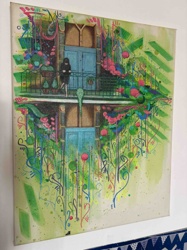
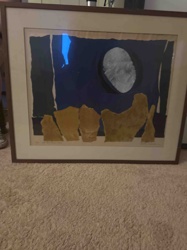
AI estimate as of July 2, 2025 · verify with a professional before acting
AI-Generated · Verify before acting
Everything on this page is generated by AI for informational purposes only. AI can make mistakes — the AI may misidentify items or misattribute them (artist, maker, brand, designer, origin, era). This is not an official valuation and should not be used for insurance, sale, tax, estate, legal, or lending purposes — or any decision requiring a certified appraisal. It is not an authoritative claim about any person, brand, or rights holder — do not share or rely on it as a factual statement about a third party. Always consult qualified professionals before making financial decisions.
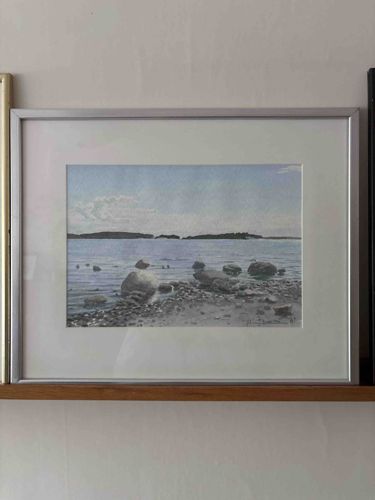
This item is a framed landscape artwork, specifically appearing to be a watercolor painting or print, depicting a tranquil coastal or lakeside scene. The composition features a foreground with a rocky shoreline and scattered larger boulders, leading into a body of water that recedes towards several distant landmasses or islands under a soft, light blue sky with faint cloud formations. The dominant colors are muted blues, grays, and browns, indicative of a serene natural environment. The water exhibits subtle ripples and reflections, suggesting a calm state. The artwork is housed within a contemporary-style frame made of what appears to be brushed aluminum or a similar light-silver-toned metal, featuring a clean, flat profile. It is matted with a wide, off-white or light cream mat board, which accentuates the artwork and provides visual breathing room. The presence of visible reflections on the glazing (likely glass or acrylic) indicates that the piece is protected. No discernible maker's marks or signatures are visible in the provided image. The overall condition appears good, with no obvious signs of damage to the frame, mat, or artwork itself, though the reflective surface makes it hard to inspect the artwork in minute detail. The style suggests a realistic or naturalistic approach, possibly dating from the late 20th to early 21st century given the framing choice. The craftsmanship of the matting and framing appears professional, contributing to the overall presentation.
AI Appraisal Report
Upon examining the provided image of this framed coastal/lake landscape artwork, I observe a tranquil scene likely depicted in watercolor or as a high-quality print. The composition, featuring a rocky foreground transitioning to calm water and distant landforms under a soft sky, suggests a serene aesthetic. The muted color palette of blues, grays, and browns reinforces this naturalistic feel. The artwork is professionally presented within a contemporary brushed aluminum or similar light-silver-toned metal frame, complemented by a wide, off-white mat board. The glazing, likely glass or acrylic, shows reflections, indicating protection but also limiting the minute inspection of the artwork's surface for subtle details like brushstrokes or paper texture.
Based on visual assessment, the condition appears good; I see no obvious damage to the frame, mat, or the visible portions of the artwork. However, without direct physical examination, I cannot definitively confirm the medium (original watercolor vs. print) or assess potential foxing, fading, or minor abrasions that reflections might obscure. The absence of a visible signature or maker's mark significantly impacts value, as attribution to a known artist would considerably increase its market appeal.
In terms of market conditions, unsigned or unattributed landscape art with a decorative aesthetic typically falls within a broad value range. Comparables in the retail market for original, unlisted artist watercolors of this size and quality of framing might range from $150 to $400. If it were determined to be a fine art print (e.g., giclée) by an unlisted artist, the value would be lower, likely $75-$200. Demand for serene landscapes remains consistent, primarily for decorative purposes. Rarity is difficult to ascertain without knowing the artist or production quantity (if a print).
Key factors impacting value here are the unknown artist and medium. A definitive determination of the medium (original vs. print), identification of the artist, and any provenance documentation would be crucial for a more precise valuation. Without physical inspection, I cannot verify authenticity beyond a visual appraisal of its decorative quality and condition. To fully authenticate, an in-person examination would be required to analyze brushwork, paper type, and printing techniques, potentially under magnification, and to search for hidden signatures or edition numbers.