AI Appraisal Estimate

AI-generated estimates · not official valuations

From the user

What was submitted

Photo and notes provided by the user — not generated by AI

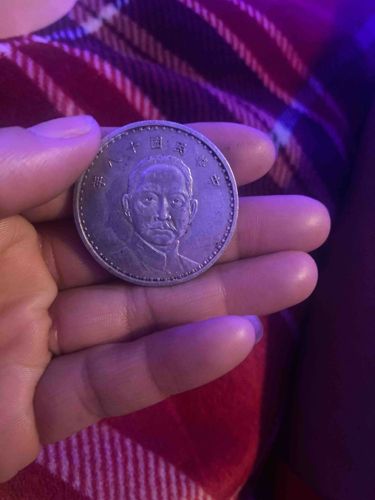
Submitted item photo
Submitted photo · June 6, 2026

User's notes

No additional notes provided.

AI analysis below

AI appraisal

AI analysis & estimate

AI-Generated · Verify before acting

Everything below is generated by AI for informational purposes only. AI can make mistakes — the AI may misidentify items or misattribute them (artist, maker, brand, designer, origin, era). This is not an official valuation and should not be used for insurance, sale, tax, estate, legal, or lending purposes — or any decision requiring a certified appraisal. It is not an authoritative claim about any person, brand, or rights holder — do not share or rely on it as a factual statement about a third party. Always consult qualified professionals before making financial decisions.

Read the full disclaimer

AI Identification

·Not independently authenticated·Verify before acting

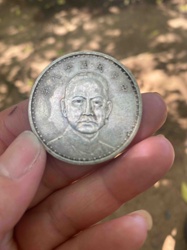
Republic of China (1921) Yuan Shikai "Fat Man" Silver Dollar

Coin / Numismatic Collectible

AI Estimated Value

·Not an official valuation·Verify before acting

$60-90

As of June 6, 2026

AI Item Analysis

·AI can make mistakes·Verify before acting
This artifact is a circular silver-colored coin, commonly known as a "Fat Man" dollar, issued during the Republic of China era. Based on the visible inscription, it dates to the 10th year of the Republic, corresponding to 1921. The obverse prominently features a left-facing bust portrait of Yuan Shikai, a significant political figure from early 20th-century China, depicted in military attire. Surrounding the portrait are Chinese characters reading "中華民國十年" (Republic of China, Year Ten), clearly marking its issuance date. The coin has a distinct beaded border along its rim, typical of the series. While the reverse is not visible in the image, these particular coins almost always feature two crossed stalks of grain enclosing the Chinese characters "壹圓" (One Yuan). The material is a silver alloy, consistent with the coinage standards of the period. Its current condition suggests moderate to heavy circulation, with visible wear on the high points of the portrait and some softening of the lettering, resulting in a uniform, circulated gray patina rather than original mint luster. There are no immediately apparent significant damages such as deep scratches, large nicks, or active corrosion, although precise minor surface blemishes would require a higher resolution examination. The craftsmanship is appropriate for mass-produced coinage of the era, showcasing clear, albeit worn, engraving. This coin is an important piece representing a crucial period of political and economic transition in Chinese history and is a staple in numismatic collections focusing on East Asian currency.
AI Appraisal Report

·AI can make mistakes·Verify before acting
Based on my examination of the provided description for this Republic of China (1921) Yuan Shikai 'Fat Man' Silver Dollar, its condition suggests a genuinely circulated piece. The obverse displays moderate to heavy circulation wear, evident in the softened features of Yuan Shikai's bust and diminished clarity of the surrounding inscriptions. The uniform grey patina is consistent with extended natural circulation, lacking any original mint luster. There are no immediate signs of significant damage like deep scratches or nicks, typically associated with lower value, and the craftsmanship appears appropriate for period coinage. This 'Fat Man' dollar, especially the 1921 (Year 10) issue, is one of the most common and widely collected Chinese silver coins. Market demand remains consistently strong due to its historical significance and iconic status in Asian numismatics. However, its ubiquitous nature means that circulated examples are not rare. This commonality, combined with the described wear, significantly limits its value compared to higher-grade examples or rarer dates/varieties. Its primary drivers for value are its historical appeal and inherent silver content. A major limitation to a definitive appraisal and authenticity verification is the reliance solely on a description. Physical examination is paramount to properly assess weight, diameter, thickness, specific gravity, and edge reeding, which are critical security features. The reverse being unseen also prevents confirmation of the standard design and any potential varieties or damage. For full authentication, in-person inspection, including microscopic analysis of die characteristics, and potentially elemental analysis for alloy confirmation, would be required. Provenance documentation would further enhance confidence in its legitimacy. Without these, my assessment of authenticity is based purely on the described visual characteristics which align with known genuine circulated examples.

Get your items appraised

Instant estimates of your treasures with AI-powered appraisals

Browse More Appraisals