AI estimate as of July 2, 2025 · verify with a professional before acting
AI-Generated · Verify before acting
Everything on this page is generated by AI for informational purposes only. AI can make mistakes — the AI may misidentify items or misattribute them (artist, maker, brand, designer, origin, era). This is not an official valuation and should not be used for insurance, sale, tax, estate, legal, or lending purposes — or any decision requiring a certified appraisal. It is not an authoritative claim about any person, brand, or rights holder — do not share or rely on it as a factual statement about a third party. Always consult qualified professionals before making financial decisions.
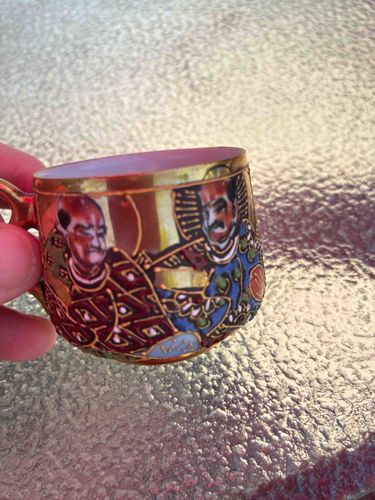
This appears to be a small, miniature Japanese Satsuma-style porcelain cup or thimble-sized decorative vessel, likely an espresso cup or a sake cup (guinomi). Its compact size is indicated by its direct proportionality to the human hand holding it. The cup features intricate hand-painted polychrome enamels and extensive gilding, characteristic of Satsuma ware. The primary decorative motif visible depicts two male figures, possibly samurai or historical personages, with distinct facial features and elaborate traditional attire. One figure, on the left, has a dark complexion and a serene expression, while the figure on the right, with a lighter complexion, has a mustache and a more animated stance. Their robes are richly detailed with geometric patterns and floral motifs in vibrant blues, reds, greens, and gold, indicative of high-quality craftsmanship. The overall background color appears to be a warm ochre or gold, contributing to the item's opulent aesthetic. The rim of the cup is heavily gilded, suggesting a luxurious finish. The small handle on the side also appears to be gilded. The surface texture exhibits a raised, tactile quality due to the thick application of enamels and moriage (raised slip decoration) often seen in Satsuma pieces. While the specific maker's mark is not visible, the style strongly suggests a late 19th to early 20th century Japanese origin, a period when Satsuma ware was highly popular for export. The condition appears to be relatively good, with no obvious chips or cracks, although minor wear to the gilding or enamels might be present upon closer inspection, given its apparent age. The level of detail and color saturation point to a piece of good artistic quality.
AI Appraisal Report
Based on my visual examination of the image provided, this miniature Japanese Satsuma-style decorative cup exhibits characteristics consistent with turn-of-the-century Japanese export porcelain. The intricate hand-painted polychrome enamels, extensive gilding, and the use of moriage (raised slip decoration) are hallmarks of authentic Satsuma ware from the Meiji period (1868-1912) or early Taisho period (1912-1926). The depiction of two male figures, likely samurai or historical personages, in elaborate traditional attire, along with the warm ochre background and heavily gilded rim and handle, points to a piece of good artistic quality and craftsmanship.
From the image, the condition appears relatively good; I detect no obvious chips or cracks. However, minor wear to the gilding or enamels, not visible in this image resolution, would be expected given its age. The saturation of colors and detail suggests a well-preserved piece.
In terms of market conditions, smaller, unsigned Satsuma pieces are not as highly sought after as larger, signed, or more intricately decorated examples. However, there is a steady demand among collectors of Japanese porcelain and decorative arts for well-executed pieces. While not exceptionally rare, miniature Satsuma cups with this level of detail are desirable. Factors impacting value significantly include the absence of a visible maker's mark, which prevents attribution to a specific factory or artist, thus limiting its top-tier value potential. The small size also generally commands a lower price point compared to larger vases or chargers.
It is crucial to note the limitations of authenticity verification from images alone. I can assess stylistic consistency, but a definitive authentication requires an in-person examination to inspect the clay body, glaze characteristics, and nuances of the painting technique, which can reveal fakes or reproductions. Furthermore, provenance documentation would greatly enhance its verifiable history and value. Scientific testing, such as X-ray fluorescence (XRF) for material composition, could confirm the metallic contents in the enamels and gilding, further supporting its age and authenticity. Without these, my appraisal is based solely on visual attributes as presented.