AI estimate as of August 27, 2025 · verify with a professional before acting
AI-Generated · Verify before acting
Everything on this page is generated by AI for informational purposes only. AI can make mistakes — the AI may misidentify items or misattribute them (artist, maker, brand, designer, origin, era). This is not an official valuation and should not be used for insurance, sale, tax, estate, legal, or lending purposes — or any decision requiring a certified appraisal. It is not an authoritative claim about any person, brand, or rights holder — do not share or rely on it as a factual statement about a third party. Always consult qualified professionals before making financial decisions.
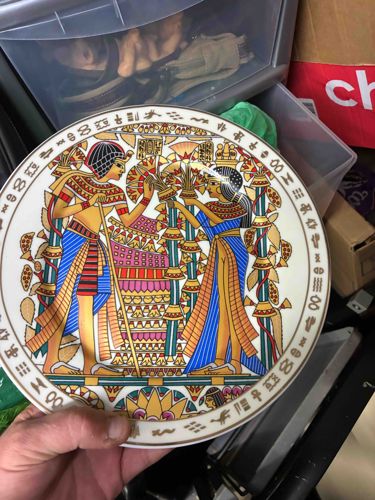
This is a round, flat decorative plate, likely made of ceramic or porcelain, given its smooth, glossy finish and the nature of similar collectible items. The central motif depicts two figures in ancient Egyptian-style dress, rendered in vibrant colors including blues, reds, yellows, and oranges, with significant use of gold accents to highlight details and create a sense of opulence. The figures appear to be engaged in some form of ritual or interaction, surrounded by stylized Egyptian flora and architectural elements. The left figure (male, based on typical Egyptian iconography) wears a striped kilt and a royal headdress, holding a staff. The right figure (female) wears a flowing blue gown and an ornate headdress, interacting with columns that resemble papyrus or lotus stalks. The overall design features a high degree of detail, particularly in the clothing patterns and the surrounding decorative motifs which include hieroglyphic-like symbols and geometric patterns. A prominent border encircles the main illustration, featuring repeated hieroglyphic characters or decorative symbols in gold on a cream background. The condition appears to be good with no obvious chips, cracks, or significant wear visible from the provided image. The gold accents appear intact, suggesting good preservation or limited handling. The craftsmanship appears to be of a reasonable quality for a decorative plate, with clear lines and vibrant colors, though it's likely a mass-produced collectible rather than a handcrafted artisan piece. The style period is clearly inspired by Ancient Egyptian art and iconography, making it a "Neo-Egyptian" or "Egyptomania" piece, likely produced in the late 20th or early 21st century. No discernible maker's marks or signatures are visible on the front of the plate.
AI Appraisal Report
Upon my virtual examination of this decorative plate, I observe it to be a mass-produced, Neo-Egyptian themed item, likely ceramic or porcelain, dating from the late 20th or early 21st century. The condition appears very good, with no visible chips, cracks, or significant wear to the vibrant colors or gold accents. This suggests careful display or limited handling. The craftsmanship, while commendable for a decorative piece, indicates it is a collectible rather than an antique artisan work.
Authenticity, in terms of it being a genuine 'decorative plate' and not a period Egyptian artifact, is readily confirmed by its stylistic qualities, clear industrial production, and condition. However, without physical examination, I cannot comment on specific manufacturing techniques, material composition, or the presence of maker's marks, which are often found on the reverse.
The market for Neo-Egyptian decorative items is generally robust but highly saturated, impacting rarity. While attractive, similar plates are widely available from various manufacturers, placing it in a common collectible category. Demand is consistent for well-preserved examples, but not exceptionally high. The value is primarily driven by its aesthetic appeal and good condition, rather than intrinsic rarity, historical significance, or artistic mastery. To fully authenticate its precise origin, an in-person examination for maker's marks, material analysis, and provenance documentation (e.g., original packaging, sales receipts) would be necessary, though unlikely to significantly alter the appraisal given its nature.