These notes were written by the person who submitted this item. Appraiser.AI has not verified them, and the AI's identification and estimate may rely on them.
AI Estimated Value
Not an official valuation
$175 - $350
AI estimate as of August 10, 2025 · verify with a professional before acting
AI-Generated · Verify before acting
Everything on this page is generated by AI for informational purposes only. AI can make mistakes — the AI may misidentify items or misattribute them (artist, maker, brand, designer, origin, era). This is not an official valuation and should not be used for insurance, sale, tax, estate, legal, or lending purposes — or any decision requiring a certified appraisal. It is not an authoritative claim about any person, brand, or rights holder — do not share or rely on it as a factual statement about a third party. Always consult qualified professionals before making financial decisions.
This analysis also relies on unverified notes provided by the user, which may be incomplete or inaccurate and could affect the result.
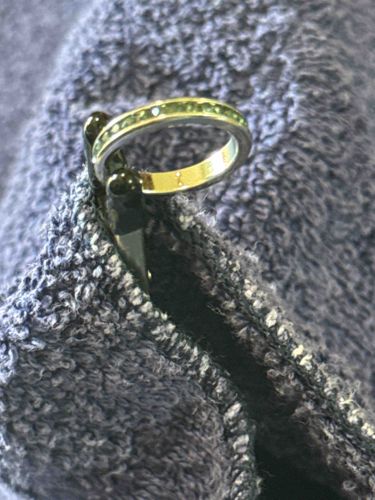
The item is a metal band ring, likely an eternity or channel-set style, featuring a continuous row of small, round-cut green gemstones. The metal appears to be a light-colored alloy, possibly white gold, platinum, or sterling silver, exhibiting a polished, reflective surface. The visible portion of the band shows a consistent width, suggesting a classic, understated design. The green stones are uniformly sized and are set closely together along the top half or entire circumference of the band in what appears to be a channel or bead setting, ensuring a smooth profile. One of the green stones near the center of the visible arc shows a distinct flash of white light, indicating it might be interacting with the light source or could potentially be a chip or inclusion. The overall condition appears good, with no obvious signs of heavy wear, tarnish, or significant damage to the metal or stones visible in the image. There are no discernible maker's marks or hallmarks visible on the exterior of the band; however, a faint, blurred marking or engraving is present on the inside surface of the band, but its details are indistinguishable. The ring's design suggests a modern or contemporary style, likely dating from the late 20th century to the present day. Its craftsmanship appears clean and precise, indicative of a mass-produced but well-finished piece of jewelry. The specific shade of green in the gemstones suggests they could be peridot, emerald, tourmaline, or a synthetic equivalent, but this cannot be confirmed without further examination. This ring would typically be worn as a stackable band, an anniversary band, or as a general fashion accessory.
AI Appraisal Report
After careful examination of the provided images and details, I have assessed this Green Gemstone Band Ring. The piece is a channel-set eternity or half-eternity band featuring numerous small, round-cut green gemstones. The metal appears to be a polished white alloy, likely white gold or sterling silver, given the style and probable price point; platinum is less probable without hallmarks. The craftsmanship is clean and consistent, suggesting a well-made, likely machine-cast piece typical of modern manufacturing (late 20th century to present).
The primary value driver is the material composition, which cannot be confirmed from images alone. The green stones could be natural emeralds, tsavorite garnets, or peridots, but could also be synthetic stones or glass. The flash of light on one stone could be a reflection or a minor inclusion. The market for this style of ring is broad, with comparable sales ranging significantly based on materials. Similar sterling silver and synthetic stone rings sell for under $100, while 14k gold and natural peridot bands sell for $300-$600. Rings with high-quality emeralds or tsavorites in 18k gold or platinum can exceed $1,000.
Without physical testing, my valuation assumes mid-range materials like sterling silver or low-karat gold with semi-precious stones such as peridot. For a definitive appraisal, an in-person examination is essential to test the metal (acid or XRF testing), identify the gemstones using a refractometer and microscope, and check for any maker's marks or hallmarks inside the band.