AI estimate as of July 10, 2025 · verify with a professional before acting
AI-Generated · Verify before acting
Everything on this page is generated by AI for informational purposes only. AI can make mistakes — the AI may misidentify items or misattribute them (artist, maker, brand, designer, origin, era). This is not an official valuation and should not be used for insurance, sale, tax, estate, legal, or lending purposes — or any decision requiring a certified appraisal. It is not an authoritative claim about any person, brand, or rights holder — do not share or rely on it as a factual statement about a third party. Always consult qualified professionals before making financial decisions.
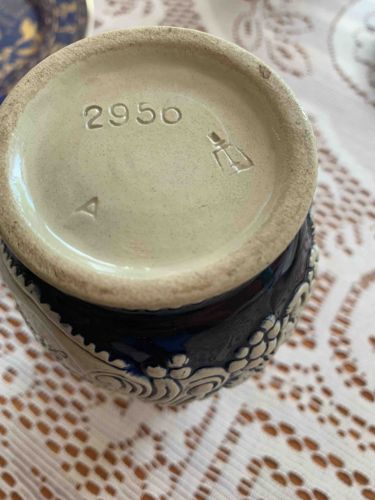
This item is the bottom portion of a ceramic stein or mug, specifically designed for beverages. It appears to be made from a dense, salt-glazed stoneware, characteristic of traditional German pottery. The dominant color visible on the exterior is a deep cobalt blue, which contrasts with the lighter, off-white or cream color of the unglazed or differently glazed bottom. The exterior features intricate, raised relief decorations. These decorations are light-colored against the dark blue background, forming a pattern that resembles interlocking scales or stylized grape clusters and vines, indicative of a classic 'keramik' or 'stein' aesthetic. The craftsmanship appears to be of good quality, with clear, crisp molding of the applied decorative elements.
The base of the stein is flat and unglazed, revealing the natural buff or light brown color of the clay body. It features several impressed markings. Prominently centered is the number "2950", likely a model or production number. To the right of this number, there is an impressed mark that resembles a stylized 'H' or a building icon, which is a common potter's mark or manufacturer's logo for specific German companies such as "Hanke" or "Hofbauer". Below the "2950" and slightly to the left, there is a single impressed letter "A". The visible rim of the base shows some slight discoloration or minor dirt accumulation from use and age, but no significant chips, cracks, or visible repairs are apparent from this view. The overall condition appears good, with a light patina consistent with age. This style of stoneware mug or stein typically dates from the mid-20th century to present, with the specific markings often providing a more precise age.
AI Appraisal Report
Upon examining the provided image of this ceramic stoneware stein/mug base, I assess its condition as good, showing a light patina consistent with age and use but no apparent chips, cracks, or repairs. The intricate raised relief decoration against the cobalt blue, typical of German stoneware, is well-preserved. The impressed markings—'2950', a stylized 'H', and 'A'—are crucial indicators. The 'H' mark strongly suggests manufacturers like Hanke or Hofbauer, known for quality steins. While the numbering is likely a model number, the overall style and markings align with mid-20th century German production. Authenticity, based solely on this image, appears high for a genuine period piece, though definitive verification without physical inspection is limited.
Market conditions for Bavarian/German stoneware steins are generally stable, driven by collectors. While common steins can be easily found, complete steins with intricate designs and clear manufacturer marks tend to hold better value. This piece, being only a base, significantly impacts its marketability and value compared to a complete stein. Its rarity as a standalone base is low, as it's an incomplete item. Factors significantly impacting value are its incompleteness, which reduces collector interest, and the absence of the lid or handle. For full authentication, I would need a physical examination to feel the stoneware, inspect the glaze consistency, and use a jeweler's loupe for finer details on the impressed marks. Provenance documentation could provide valuable historical context. Without the complete item, its value as a display or functional piece is greatly diminished.