Photo and notes provided by the user — not generated by AI
Submitted photo · June 16, 2026
User's notes
No additional notes provided.
AI analysis below
AI appraisal
AI analysis & estimate
AI-Generated · Verify before acting
Everything below is generated by AI for informational purposes only. AI can make mistakes — the AI may misidentify items or misattribute them (artist, maker, brand, designer, origin, era). This is not an official valuation and should not be used for insurance, sale, tax, estate, legal, or lending purposes — or any decision requiring a certified appraisal. It is not an authoritative claim about any person, brand, or rights holder — do not share or rely on it as a factual statement about a third party. Always consult qualified professionals before making financial decisions.
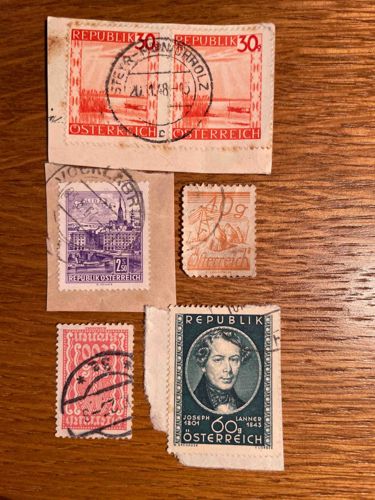
This item is a collection of six distinct used postage stamps from Austria (Österreich), affixed to various backing papers or segments of envelopes. The stamps vary in size, color, and design, indicating different denominations and historical periods.
Starting from the top, there is a reddish-orange stamp horizontally oriented, featuring the text 'REPUBLIK' and 'ÖSTERREICH' at the top and bottom respectively, with a denomination of '30'. It depicts a landscape scene, possibly a river or lake with mountains in the background. This stamp carries a clear circular postmark with discernible text 'STEYR-GARNHOLZ' and a date '1948'. Adjacently, a smaller, square-shaped stamp in light purple shows a cityscape with prominent buildings and a tower, bearing 'REPUBLIK ÖSTERREICH' and a '2' (likely Groschen or Schilling) denomination. A circular postmark partially obscures the top portion of this stamp.
To the right of the purple stamp, there's a small, rectangular orange stamp with '40g' and 'Österreich' visible, featuring an industrial or agricultural scene, possibly depicting oil extraction or industry with derricks. Its edges appear somewhat rough.
Below the purple stamp, a rectangular red stamp with a distinct pattern and a '50' denomination is visible. It has a heavy, wavy black postmark obscuring much of its design, making specific details hard to discern, though 'GROSCHEN' can be faintly read.
Finally, at the bottom right, a prominent rectangular dark teal or blue stamp portrays a portrait of a man, identified by the inscription 'JOSEPH LANNER 1801-1843'. The denomination '60g' and 'ÖSTERREICH' are clearly visible at the bottom. The stamp's backing paper is unevenly torn, suggesting it was part of a larger piece.
Overall condition varies. Some stamps show wear, creasing, and discoloration consistent with being used and having postal marks applied. The paper quality seems standard for postage stamps of their respective eras. The postmarks indicate they have been through the postal system. The presence of multiple denominations and historical figures/scenes suggests a philatelic interest, potentially representing different series or issues from mid-20th century Austria given the visible date of 1948 on one stamp. The craftsmanship appears to be standard governmental printing for postage stamps, with some variation in perforation and paper cuts.
AI Appraisal Report
·AI can make mistakes·Verify before acting
Upon visual examination of this collection of six used Austrian postage stamps, I assess their condition as generally fair to good, consistent with used postal items. Authenticity appears straightforward; these are common, mass-produced stamps from mid-20th century Austria, and there's no immediate indication of forgery. The clear '1948' postmark on the reddish-orange '30' denomination stamp firmly places at least one item in that era, suggesting the others are likely contemporaneous or from a similar period.
Market conditions for used, common Austrian stamps from this period are generally low. These stamps, while historically interesting, are not rare, nor do they appear to be in pristine condition. The heavy postmark on the red '50 GROSCHEN' stamp and the rough edges on the orange '40g' stamp detract from their individual aesthetic appeal and marketability. The backing paper and envelope segments they are affixed to are inconsequential to value. Demand is primarily from beginner collectors or those looking for representative examples of Austrian postal history, not from advanced philatelists seeking high-grade or rare issues.
Factors impacting value negatively include their used condition, commonality, and the obscuring postmarks. Positively, they are genuine, distinct stamps.
Limitations in authenticity verification from images alone are minimal for such common stamps but would typically involve examining paper type, watermarks (if applicable), and perforation details under magnification for definitive authentication. Provenance documentation is not usually a factor for stamps of this type. Scientific testing is wholly unnecessary given the common nature of these particular items.