AI estimate as of September 12, 2025 · verify with a professional before acting
AI-Generated · Verify before acting
Everything on this page is generated by AI for informational purposes only. AI can make mistakes — the AI may misidentify items or misattribute them (artist, maker, brand, designer, origin, era). This is not an official valuation and should not be used for insurance, sale, tax, estate, legal, or lending purposes — or any decision requiring a certified appraisal. It is not an authoritative claim about any person, brand, or rights holder — do not share or rely on it as a factual statement about a third party. Always consult qualified professionals before making financial decisions.
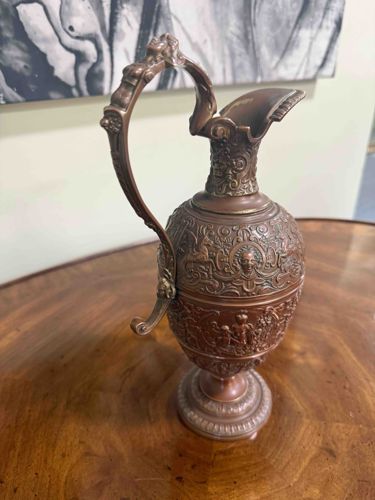
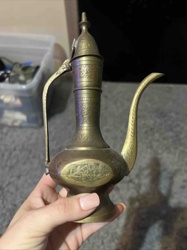
This item is an ornate ewer or jug, likely cast from bronze or a metal with a bronze-like patinated finish, presenting a rich, earthy brown color with deeper tones in the recesses, enhancing the detailed relief work. The ewer features a classic ovoid body, tapering towards a relatively narrow neck and flaring out into a stylized pouring spout. The handle is intricately designed, arching gracefully from the rim of the spout to the upper shoulder of the body. It is adorned with scrolled acanthus leaves and what appear to be figural elements or mascarons at its attachment points, exhibiting classical or Renaissance stylistic influences. The body of the ewer is extensively decorated with multiple bands of high-relief mythological or allegorical scenes, interspersed with decorative motifs such as scrolling foliage, architectural elements, and classical busts or faces. One prominent band around the upper body features a central mascaron or face flanked by winged figures and elaborate scrollwork. Below this, another band depicts a procession of classical figures, possibly cherubs or putti engaged in various activities, indicative of a continuous narrative. The lower part of the body gradually narrows to a circular, stepped foot, also adorned with decorative banding. The casting appears to be of good quality, with clear details in the relief work, suggesting skilled craftsmanship. There are no immediate signs of major damage or repairs, but the overall patina suggests age and handling, consistent with a period piece. The style points to a 19th-century European revivalist period, possibly neoclassical or Renaissance Revival, where historical forms and mythological themes were popular.
AI Appraisal Report
I have examined the provided image of this ornate ewer, likely cast from bronze or a bronze-patinated metal. Based on the visual evidence, the condition appears good, with an attractive, aged patina contributing to its aesthetic appeal. The extensive and detailed relief work, depicting mythological or allegorical scenes, scrollwork, and classical figures like cherubs or putti, signifies a high level of craftsmanship. The design, particularly the intricate handle with scrolled acanthus leaves and mascarons, strongly suggests a 19th-century European revivalist period, possibly Neoclassical or Renaissance Revival, which was popular for incorporating historical forms and mythical themes into decorative arts.
Market conditions for such decorative bronze or bronze-patinated ewers from the 19th century are generally stable. While not exceptionally rare, well-executed and finely detailed examples like this one do attract collectors interested in historical design and period specific decorative arts. Comparables include similar-sized ewers or pitchers from the Neoclassical or Renaissance Revival periods that feature elaborate relief decoration, often fetching prices in the high hundreds to low thousands, depending on provenance, artist, and overall condition. The lack of specific maker's marks or discernible artist attribution from the image limits the upper end of the valuation, as branded pieces often command a premium. The clear details in the relief work and the absence of obvious damage are positive factors.
However, it is crucial to note the limitations of assessing authenticity and material composition solely from an image. A physical examination would be necessary to confirm if the material is solid bronze, bronze-plated, or another base metal with a bronze patination, which significantly impacts value. In-person inspection would also allow for a thorough condition assessment, including detecting any hairline cracks, repairs, or re-patination that are not visible in photographs. Provenance documentation, if available, linking the ewer to a known workshop or collection, would also enhance its historical and market value significantly. Without these, the authentication of material and detailed condition remains presumptive.