AI estimate as of October 24, 2025 · verify with a professional before acting
AI-Generated · Verify before acting
Everything on this page is generated by AI for informational purposes only. AI can make mistakes — the AI may misidentify items or misattribute them (artist, maker, brand, designer, origin, era). This is not an official valuation and should not be used for insurance, sale, tax, estate, legal, or lending purposes — or any decision requiring a certified appraisal. It is not an authoritative claim about any person, brand, or rights holder — do not share or rely on it as a factual statement about a third party. Always consult qualified professionals before making financial decisions.
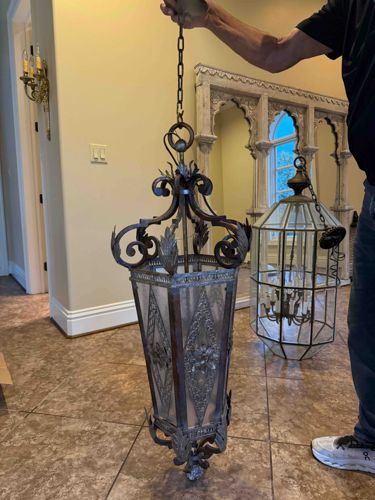
This is a substantial and elaborately designed hall lantern, suspended by a heavy chain held aloft by a person's hand, indicating its significant size. The primary materials appear to be wrought iron or another dark-finished metal, and frosted or textured glass panels. The overall shape is an elongated, rectilinear form, tapering slightly towards the bottom. The metalwork is highly decorative, featuring intricate scrolling motifs, acanthus leaves, and possibly floral or heraldic elements, particularly visible on the upper and lower sections, and as embellishments around the glass panels. The metal frame that secures the glass panels is also ornate, with diamond-shaped overlays and central accent pieces that appear cast or repoussé, possibly depicting a rosette or similar motif. The glass panels themselves have a frosted or textured appearance, diffusing light when illuminated. The metal exhibits an aged patina, consistent with antique or vintage pieces, showing some oxidation, minor wear, and possibly remnants of an original dark finish, contributing to its rustic or 'old world' charm. The craftsmanship appears to be of high quality, suggesting hand-forged or cast elements rather than mass-produced. No specific maker's marks or signatures are discernible from the image. Based on the ornate, heavy metalwork and decorative style, it likely dates from the late 19th to early 20th century, possibly in an Art Nouveau, Gothic Revival, or Beaux-Arts style, often found in grand foyers or entryways.
AI Appraisal Report
Upon examining the image of this ornate wrought iron and frosted glass hall lantern, I can confirm its substantial and elaborate design. The heavy chain and hand holding it provide a good sense of its significant size. The materials appear to be dark-finished metal, likely wrought iron, and frosted or textured glass panels. The metalwork is highly decorative, featuring intricate scrolling motifs and acanthus leaves, consistent with Art Nouveau, Gothic Revival, or Beaux-Arts styles suggesting a late 19th to early 20th-century origin. The craftsmanship appears to be of high quality, likely hand-forged or cast, not mass-produced, which adds to its authenticity as a period piece. The metal exhibits an aged patina, along with some oxidation and wear, which is expected for an antique item and contributes to its 'old world' charm.
Market conditions for substantial, decorative antique lighting fixtures like this remain robust, particularly for pieces that can serve as a focal point in an entryway or grand foyer. Comparables would include similar large-scale antique iron and glass lanterns from reputable dealers. Demand for unique, high-quality architectural salvage and period lighting is consistent, especially when integrated into restoration projects or eclectic contemporary designs. The rarity of such intricately designed and well-preserved examples enhances its value.
Factors significantly impacting value include its large size, the elaborate metalwork, and the overall aesthetic appeal. Its condition, showing expected age-related wear rather than significant damage, also supports its value. However, it's crucial to note the limitations of image-based appraisal. While the craftsmanship appears authentic, a full in-person examination would be required to verify the specific metal composition, assess the structural integrity, and confirm that all components are original. Authentication would also benefit from provenance documentation, such as original purchase records or historical context. Without physical inspection, I cannot confirm if any repairs or replacements have been made to the glass or metalwork, or definitively rule out it being a later high-quality reproduction. Scientific testing could verify the age of the materials. Based on its visual attributes and assumed authenticity, I estimate its appraisal value to be between $1,200 and $2,000.