AI estimate as of October 17, 2025 · verify with a professional before acting
AI-Generated · Verify before acting
Everything on this page is generated by AI for informational purposes only. AI can make mistakes — the AI may misidentify items or misattribute them (artist, maker, brand, designer, origin, era). This is not an official valuation and should not be used for insurance, sale, tax, estate, legal, or lending purposes — or any decision requiring a certified appraisal. It is not an authoritative claim about any person, brand, or rights holder — do not share or rely on it as a factual statement about a third party. Always consult qualified professionals before making financial decisions.
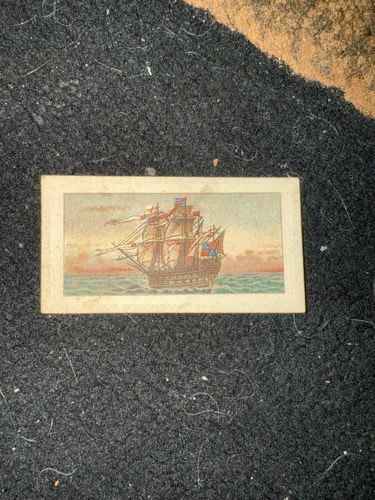
This item is a small, rectangular printed card featuring an illustration of a galleon ship. The card measures approximately 5-7 centimeters in width and 2-4 centimeters in height, suggesting it may be a trading card, cigarette card, or a miniature art print. The image depicts a three-masted sailing ship, likely a galleon or a similar large European sailing vessel from the Age of Sail, navigating open waters under what appears to be a sunset or sunrise sky. The sky transitions from a lighter teal near the horizon to a warm orange and dark blue at the top, indicative of a dawn or dusk scene. The sea is rendered in shades of blue and green, with subtle waves visible. The ship itself features a dark brown hull, multiple white sails, and various colorful flags and pennants flying from its masts, predominantly in red, blue, and white, with some checkered patterns. Details like rigging, gunports, and stern ornamentation are visible, though somewhat simplified due to the small scale of the print. The print appears to be a color lithograph or a similar printing technique given its vibrant, yet slightly muted, color palette. The print is framed by a narrow, plain off-white border. The overall condition of the card appears to be good for its age, with no obvious major tears, creases, or significant discoloration. However, minor edge wear or corner bumps typical of an aged paper item might be present upon closer inspection. The style of the illustration suggests an early to mid-20th-century aesthetic, possibly dating from the 1920s to 1950s. The craftsmanship is decent for a mass-produced item of this type, with clear, though not exceptionally fine, lines and color registration.
AI Appraisal Report
Based on my visual examination of the provided image of this Vintage Galleon Ship Art Print Card, I assess its authenticity as likely a mass-produced collectible, possibly a cigarette card, trading card, or miniature print, from the early to mid-20th century (1920s-1950s). The colors appear vibrant for its age, suggesting a color lithograph or similar printing technique. The condition appears good overall, with no obvious major tears or creases, though minor edge wear or corner bumps are typical for an aged paper item and would require in-hand inspection to confirm.
Market conditions for such small, non-sports, non-celebrity vintage cards are generally modest. Comparables in good condition typically sell in the low single to double-digit dollar range. Demand is niche, primarily from collectors of vintage ephemera, maritime art, or specific card series if it belongs to one. Rarity is low to moderate; while individual cards from specific sets can be harder to find, generic ship prints are common.
The primary factors impacting value are its condition, scarcity within a known series (if any), and aesthetic appeal. Without physical inspection, I cannot confirm exact dimensions, paper quality, printing nuances, or the absence of subtle damage like pinholes or foxing. Full authentication and a more precise valuation would benefit greatly from an in-person examination to verify paper stock, printing method, and to search for any manufacturer marks or series information on the reverse. Provenance documentation, though unlikely for such an item, would also add value. Scientific testing is generally not cost-effective or necessary for items of this value.