These notes were written by the person who submitted this item. Appraiser.AI has not verified them, and the AI's identification and estimate may rely on them.
AI Estimated Value
Not an official valuation
$125 - $200
AI estimate as of December 8, 2025 · verify with a professional before acting
AI-Generated · Verify before acting
Everything on this page is generated by AI for informational purposes only. AI can make mistakes — the AI may misidentify items or misattribute them (artist, maker, brand, designer, origin, era). This is not an official valuation and should not be used for insurance, sale, tax, estate, legal, or lending purposes — or any decision requiring a certified appraisal. It is not an authoritative claim about any person, brand, or rights holder — do not share or rely on it as a factual statement about a third party. Always consult qualified professionals before making financial decisions.
This analysis also relies on unverified notes provided by the user, which may be incomplete or inaccurate and could affect the result.
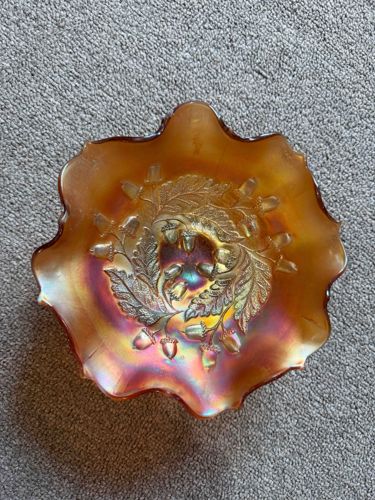
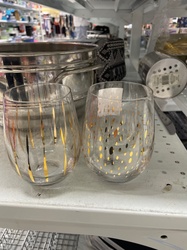
This is an iridescent carnival glass bowl featuring a deeply embossed design of acorns and oak leaves. The bowl exhibits a vibrant, shimmering iridescence, characteristic of carnival glass, with dominant hues of orange and gold that shift to purples, blues, and greens depending on the light and viewing angle. The material is pressed glass, giving it a substantial weight and texture. The edges of the bowl are ruffled or crimped, a common characteristic in carnival glass, creating an undulating, scalloped rim. The central motif depicts a stylized wreath or garland of oak leaves and numerous acorns, all raised in relief from the interior surface of the bowl. The individual details of the leaf veins and acorn caps are clearly discernible, indicating a well-executed mold. The overall shape is round with a slightly flared and irregular rim. This piece likely dates to the early 20th century, typically between 1907 and the 1920s, a period when carnival glass was highly popular. There are no obvious chips, cracks, or repairs visible from the image, suggesting good overall condition. Minor manufacturing imperfections such as mold lines or variations in iridescence are common for this type of glass and age. The quality of the iridescence and the clarity of the molded pattern suggest it could be a piece from a well-known maker like Fenton, Northwood, or Imperial, although specific maker's marks are not visible in the provided image.
AI Appraisal Report
Based on my visual examination of the provided image, this Carnival Glass Acorns and Oak Leaves Bowl presents as a fine example of early 20th-century pressed iridescent glass. The deeply embossed acorn and oak leaf design is well-executed, with clear details on the leaves and caps, indicating a good quality mold. The iridescence is particularly noteworthy, displaying the desirable shifting hues of orange, gold, purple, blue, and green, which is a key factor in assessing carnival glass quality. The ruffled or crimped edge is characteristic and well-formed. The glass gummies mentioned are not typically associated with carnival glass and might be a misidentification of manufacturing irregularities or a separate item. Assuming this is a decorative glassware, the material's weight and texture align with typical pressed glass production from the 1907-1920s era. I observe no obvious chips, cracks, or repairs, suggesting good overall condition. Minor manufacturing imperfections like mold lines are expected and do not significantly detract from value in carnival glass.
Market conditions for carnival glass generally remain stable, with well-preserved, popular patterns and vibrant iridescence commanding higher prices. The 'Acorns and Oak Leaves' pattern is recognizable, and its clarity enhances its desirability. Demand for quality carnival glass is moderate, driven by collectors. While not exceptionally rare, pieces in excellent condition with strong iridescence are always sought after. The potential attribution to makers like Fenton, Northwood, or Imperial (contingent on maker's marks, which are absent in the image), would bolster its value.
Factors significantly impacting value include the excellent condition, the vibrant and full iridescence, and the detailed pattern. Conversely, the lack of a visible maker's mark limits the top-tier valuation. My valuation of $125 - $200 reflects a strong piece in good condition. It is crucial to note that this is based solely on visual inspection of the image. For full authentication and a definitive appraisal, an in-person physical examination would be necessary to verify the absence of hairline cracks, internal flaws, and to search for microscopic maker's marks or mold numbers. Provenance documentation, if available, would also be invaluable in confirming its history and maker.