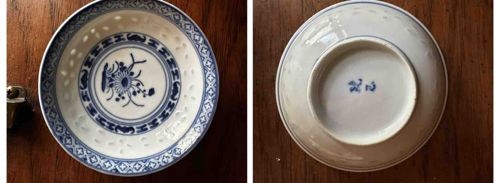
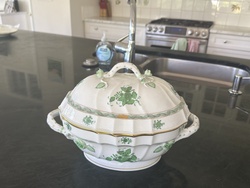
Chinese porcelain tea cup and saucer featuring the classic "rice grain" pattern, also known as "rice eye" or "rice flower"
These notes were written by the person who submitted this item. Appraiser.AI has not verified them, and the AI's identification and estimate may rely on them.
AI Estimated Value
Not an official valuation
$150-$250
AI estimate as of September 7, 2025 · verify with a professional before acting
AI-Generated · Verify before acting
Everything on this page is generated by AI for informational purposes only. AI can make mistakes — the AI may misidentify items or misattribute them (artist, maker, brand, designer, origin, era). This is not an official valuation and should not be used for insurance, sale, tax, estate, legal, or lending purposes — or any decision requiring a certified appraisal. It is not an authoritative claim about any person, brand, or rights holder — do not share or rely on it as a factual statement about a third party. Always consult qualified professionals before making financial decisions.
This analysis also relies on unverified notes provided by the user, which may be incomplete or inaccurate and could affect the result.
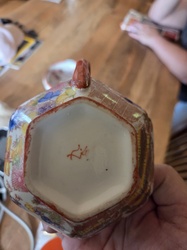
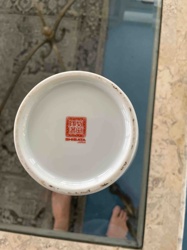
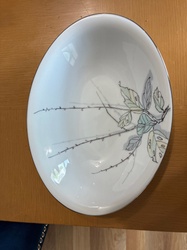
This item is a Chinese porcelain teacup or small bowl, characterized by its distinctive 'rice grain' or 'rice eye' pattern. It is primarily white porcelain with extensive blue underglaze decoration. The circular form suggests it is either a teacup (likely without a handle, typical of Asian tea sets) or a small serving bowl. The interior features a central medallion with a stylized floral or botanical motif, rendered in a vibrant cobalt blue. Surrounding this central design is a band of geometric patterns, also in blue, which transitions into the 'rice grain' sections. These sections are semi-translucent, appearing as small, symmetrically arranged holes or voids in the porcelain, which were filled with glaze during firing, creating a translucid effect resembling grains of rice. The rim is edged with a blue band, possibly with a small decorative border. The exterior of the piece, particularly the base, shows a clear blue mark, likely indicating a reign mark or factory mark, though the characters are somewhat blurry. The porcelain appears to be well-fired, indicating good craftsmanship, with a smooth, glossy glaze. There are no immediately visible chips, cracks, or significant repair marks, though the images are not high resolution enough to discern very minute imperfections. The overall aesthetic is consistent with traditional Chinese porcelain, likely from the late 19th or early 20th century given the style and commonality of 'rice grain' ware from that period. The quality seems good, with consistent color application and formation of the 'rice grain' effect.
AI Appraisal Report
I have examined the provided image and description of this Chinese Blue and White 'Rice Grain' Teacup or Small Bowl. Based on the visual evidence, the item appears to be in very good condition with no immediately visible chips, cracks, or significant repairs. The 'rice grain' or 'rice eye' pattern, a distinctive feature of this ware, is well-executed, creating the characteristic translucent effect. The underglaze cobalt blue decoration, including the central floral medallion and geometric bands, exhibits consistent color application, indicating good craftsmanship.
This style of 'rice grain' porcelain was widely produced, particularly in the late 19th and early 20th centuries, for both domestic and export markets. While popular, it is not considered exceptionally rare. The blurry blue mark on the base, as described, is likely a factory or reign mark; however, without clearer imagery or physical inspection, its precise identification and meaning cannot be definitively determined. This limits full authenticity verification from images alone. A clear image of the mark, and ideally, a physical examination, would be crucial to ascertain its authenticity and origin more precisely, which could impact value.
In terms of market conditions, 'rice grain' porcelain teacups are generally accessible. Comparables in similar condition typically sell in the range of $150 to $250 for a single cup. The lack of a matching saucer (as the description mentions a teacup and saucer set, but the image only shows the cup) also affects value, as complete sets command higher prices. Demand is steady among collectors of traditional Chinese porcelain but not particularly high for common examples. For a full authentication, I would recommend a direct examination to verify the porcelain body, glaze, and the specific details of the mark, as well as to rule out any restoration not visible in the image.