These notes were written by the person who submitted this item. Appraiser.AI has not verified them, and the AI's identification and estimate may rely on them.
AI Estimated Value
Not an official valuation
$40-70
AI estimate as of July 24, 2025 · verify with a professional before acting
AI-Generated · Verify before acting
Everything on this page is generated by AI for informational purposes only. AI can make mistakes — the AI may misidentify items or misattribute them (artist, maker, brand, designer, origin, era). This is not an official valuation and should not be used for insurance, sale, tax, estate, legal, or lending purposes — or any decision requiring a certified appraisal. It is not an authoritative claim about any person, brand, or rights holder — do not share or rely on it as a factual statement about a third party. Always consult qualified professionals before making financial decisions.
This analysis also relies on unverified notes provided by the user, which may be incomplete or inaccurate and could affect the result.
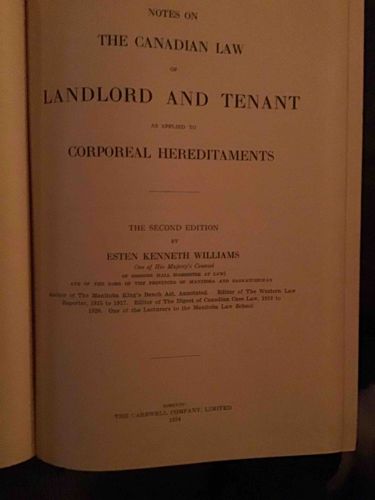
This item is a vintage legal textbook titled 'Notes on The Canadian Law of Landlord and Tenant as Applied to Corporeal Hereditaments'. Specifically, it is 'The Second Edition' of the work, authored by Esten Kenneth Williams. The book's publishing details are visible at the bottom of the page, indicating it was published by 'The Carswell Company Limited' in 1934. The page itself appears to be an interior page, likely a title page or a preliminary page, rather than the cover. It is crafted from paper, which has taken on a warm, aged cream or light brown hue, a common characteristic of older paper that has seen some exposure to light and air over time, suggesting mild toning consistent with its age. The text is printed in black ink, utilizing a combination of serif and sans-serif fonts for different sections, creating a clear hierarchy of information. The print quality appears crisp, with no significant blurring or smudging visible. The binding is not fully visible, but the slight curve of the page on the left suggests it is part of a bound book. The overall condition, based on the visible page, appears to be good; there are no apparent tears, major creases, stains, or significant foxing (age spots). The page maintains its structural integrity. The craftsmanship is typical of professional book printing from the early 20th century, with a clean layout and legible typography. The specific legal subject matter and its Canadian context, along with its specific publication date, make it a historical legal document.
AI Appraisal Report
I have examined the provided image of 'Notes on The Canadian Law of Landlord and Tenant' by Esten Kenneth Williams, Second Edition (1934), published by The Carswell Company Limited. Based on the interior page shown, the book appears to be in good condition. The paper exhibits mild, consistent toning, typical for a 1934 publication, without significant tears, creases, stains, or foxing visible on this page. The print quality is crisp, indicating good craftsmanship for the period.
This is a specialized legal textbook, and its value is primarily driven by its historical significance and rarity rather than broad collector appeal. While it holds academic interest for legal historians or researchers of Canadian law, it is not a highly sought-after collectible in the general antiquarian book market. Comparables for similar specialized legal texts from this era typically range from $30 to $100 depending on author, subject matter, and condition. The 'Good condition' assessment provided by the owner aligns with my visual assessment of the single page.
Factors impacting value include its age and the specific academic niche. Demand is limited to institutions, legal historians, or very niche collectors. While not common, it is also not exceptionally rare within the context of legal publications. Its authenticity, based solely on the visible page and publishing details, appears to be as described. However, a full authentication would require in-person examination to verify the entire book's condition, binding integrity, and to rule out any alterations or missing pages. Provenance documentation, though unlikely for such a book, would further solidify its history. Scientific testing, such as paper analysis, is generally not warranted for items in this value range but could confirm the paper's age if genuineness were disputed.