AI Appraisal Estimate

AI-generated estimates · not official valuations

From the user

What was submitted

Photo and notes provided by the user — not generated by AI

Submitted item photo
Submitted photo · May 28, 2026

User's notes

Clay50 years

AI analysis below

AI appraisal

AI analysis & estimate

AI-Generated · Verify before acting

Everything below is generated by AI for informational purposes only. AI can make mistakes — the AI may misidentify items or misattribute them (artist, maker, brand, designer, origin, era). This is not an official valuation and should not be used for insurance, sale, tax, estate, legal, or lending purposes — or any decision requiring a certified appraisal. It is not an authoritative claim about any person, brand, or rights holder — do not share or rely on it as a factual statement about a third party. Always consult qualified professionals before making financial decisions.

Note

This analysis also relies on unverified notes provided by the user, which may be incomplete or inaccurate and could affect the result.

Read the full disclaimer

AI Identification

·Not independently authenticated·Verify before acting

Inlaid Celadon Bowl (Buncheong or Goryeo Style)

Asian Art Ceramics

AI Estimated Value

·Not an official valuation·Verify before acting

$100 - $150

As of May 28, 2026

AI Item Analysis

·AI can make mistakes·Verify before acting
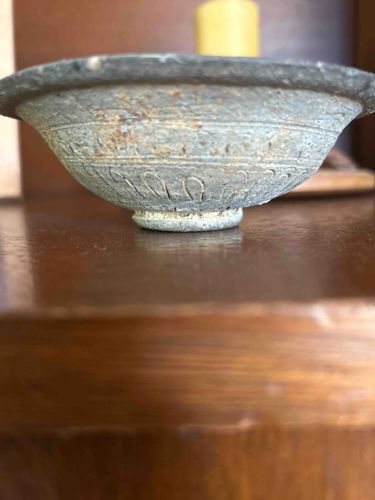
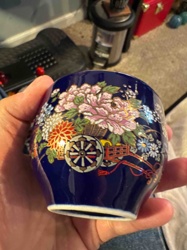
This is a small, low-profile ceramic bowl crafted from a dense clay body with an aged, weathered surface. The piece features a characteristic flared rim and a tapered body resting on a narrow footring. The exterior is decorated with traditional incised or impressed patterns, including a band of geometric linework near the rim and stylized petal or 'raindrop' motifs encircling the lower half. The coloration is a muted, earthy grey with hints of greenish-blue consistent with celadon glazes that have undergone significant surface degradation or burial wear. The texture is rough and matte, showing substantial encrustations, mineral deposits, and ochre-colored oxidation across the exterior surface, which suggests a significant period of time spent in a subterranean environment. While the user identifies the age as 50 years, the aesthetic and physical weathering strongly mimic Buncheong or late Goryeo-period Korean ceramics, making it either a genuine antique or a highly distressed decorative piece. Small chips and abrasions are visible along the foot and rim, contributing to a heavily patinated appearance. The craftsmanship shows intentionality in the symmetry of the incised bands, though the current condition obscures the original smoothness of the glaze.
AI Appraisal Report

·AI can make mistakes·Verify before acting
I have carefully examined the provided images of this celadon-style inlaid bowl. The piece exhibits decorative elements characteristic of Korean Buncheong or late Goryeo-period 'sanggan' techniques, specifically the inlaid geometric bands and 'raindrop' radiating motifs. However, there is a distinct discrepancy between the visual physical degradation and the owner's declaration of a 50-year age. To the eye, the heavy encrustations and surface oxidation suggest centuries of burial; yet, for a piece only 50 years old, this 'weathering' is likely a deliberate chemical distressing aimed at mimicking an archaeological find. The glaze lacks the vitreous depth of genuine Goryeo celadon and instead appears as a matte, treated surface. In the current market, authentic Buncheong-ware from the 15th century can command thousands of dollars, but high-quality mid-century decorative reproductions intended for the export or gift market generally trade in the $100 to $200 range. The value is limited by the intentionality of its 'distressed' state, which may be more appealing to interior designers than serious antiquarians. Limitations: From digital images, it is impossible to verify if the encrustation is calcium-based (natural) or an applied resin-and-dirt mixture. A definitive valuation would require an in-person tactile inspection of the footring for clay density and a microscopic analysis of the glaze-to-body interface. Provenance documentation or a thermoluminescence (TL) test would be required to elevate this from a decorative piece to a certified antique.

Get your items appraised

Instant estimates of your treasures with AI-powered appraisals

Browse More Appraisals