These notes were written by the person who submitted this item. Appraiser.AI has not verified them, and the AI's identification and estimate may rely on them.
AI Estimated Value
Not an official valuation
$25 - $40
AI estimate as of November 15, 2025 · verify with a professional before acting
AI-Generated · Verify before acting
Everything on this page is generated by AI for informational purposes only. AI can make mistakes — the AI may misidentify items or misattribute them (artist, maker, brand, designer, origin, era). This is not an official valuation and should not be used for insurance, sale, tax, estate, legal, or lending purposes — or any decision requiring a certified appraisal. It is not an authoritative claim about any person, brand, or rights holder — do not share or rely on it as a factual statement about a third party. Always consult qualified professionals before making financial decisions.
This analysis also relies on unverified notes provided by the user, which may be incomplete or inaccurate and could affect the result.
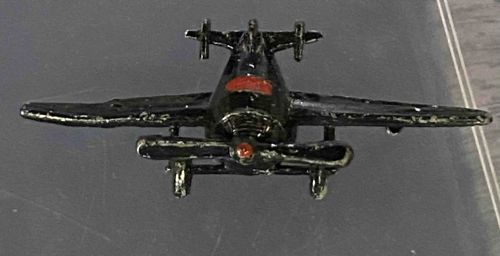
This item is a vintage brooch crafted in the shape of a single-engine, propeller-driven airplane. The entire piece is rendered in a dark, seemingly black, enamel or paint finish, which shows significant wear, revealing hints of possibly a metallic base layer underneath, particularly along the edges and raised areas of the wings and fuselage. The airplane features a distinctive broad wingspan, and what appear to be landing gear struts are visible beneath the wings. A small, circular element at the front, likely representing the propeller hub, is highlighted in a reddish-orange color. Similarly, a splash or detail on the top fuselage, just behind the cockpit area, is also in this reddish-orange hue, possibly indicating a canopy or decorative marking. The construction appears to be a cast metal, given the slightly textured and imperfect surface, characteristic of older novelty jewelry. The finish has numerous chips, scratches, and areas of paint loss, indicating considerable age and use. The rear of the aircraft shows a tailfin and horizontal stabilizers, though details are somewhat obscured by the dark finish and wear. Due to the visible wear and the style, it likely dates from the mid-20th century, possibly as a souvenir or military-themed accessory. The overall craftsmanship is functional rather than fine art, typical of costume jewelry of the era.
AI Appraisal Report
I've had the opportunity to examine the provided image of this vintage black airplane brooch. My assessment indicates a condition that I would describe as fair to good, primarily due to the extensive wear on the black enamel or paint finish. Authenticity as a vintage novelty item from the mid-20th century seems very plausible given the style, apparent construction (cast metal), and the nature of the wear. The chips, scratches, and paint loss are consistent with age and use for an item of this type. The reddish-orange accents add a touch of character, possibly indicating a specific model or decorative flair.
From a market perspective, comparable vintage airplane brooches, particularly those with significant paint loss like this example, generally fall within the lower-to-mid range for costume jewelry. While there is a niche market for vintage souvenir or military-themed accessories, the overall craftsmanship, while functional, does not suggest fine jewelry or an artisan piece. Demand is moderate, driven mainly by collectors of unique vintage brooches or aviation memorabilia, but pieces with this level of cosmetic wear tend to be less sought after than those in pristine condition. Rarity is difficult to ascertain precisely without more information; similar novelty airplane designs were common.
Factors significantly impacting value here are primarily the condition of the finish and the material. If the underlying metal were sterling silver or a higher-value alloy, the value would be greater, even with the paint loss. However, it appears to be base metal. Without an in-person examination, it's impossible to definitively confirm the base metal or the precise age. Full authentication would benefit from an in-hand inspection to assess weight, material composition (e.g., specific gravity or acid testing if appropriate and non-damaging), and the construction of the pin mechanism on the reverse. Provenance, such as original packaging or documentation, would also add to its historical value, though such items are rarely retained for costume jewelry. Based on my visual examination, I would place its current market value in the range of $25 to $40.