AI estimate as of July 12, 2025 · verify with a professional before acting
AI-Generated · Verify before acting
Everything on this page is generated by AI for informational purposes only. AI can make mistakes — the AI may misidentify items or misattribute them (artist, maker, brand, designer, origin, era). This is not an official valuation and should not be used for insurance, sale, tax, estate, legal, or lending purposes — or any decision requiring a certified appraisal. It is not an authoritative claim about any person, brand, or rights holder — do not share or rely on it as a factual statement about a third party. Always consult qualified professionals before making financial decisions.
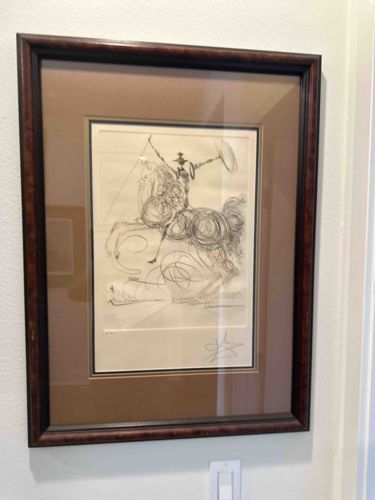
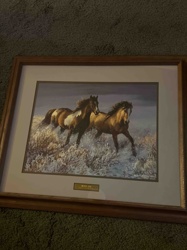
This is a framed art print, likely a lithograph or etching, depicting a dynamic scene of a figure on horseback. The artwork prominently features a stylized representation of Don Quixote, recognizable by his lance and shield, riding a horse composed of swirling lines and abstract forms. The overall style suggests a surrealist or expressionistic approach. The lines are fluid and energetic, with a notable use of circular motifs to convey motion and form, particularly in the horse's body. The print is monochrome, primarily black and white or dark grey on a light background. There's a visible signature in the lower right corner of the print itself, which strongly resembles the distinctive 'Dalí' signature, suggesting it is a work by or attributed to Salvador Dalí. Below this, there appears to be additional text or numbering, although it is not clearly legible from the image. The print is housed within a dark brown wooden frame with a visible grain, possibly mahogany or a similarly dark-toned wood. The frame has a classic, slightly ornate profile. It is matted with a neutral, light brown or tan mat board, providing a visual border between the artwork and the frame. The glass covering the print shows some reflections, indicating it is likely standard framing glass. No significant condition issues like tears, stains on the print, or damage to the frame or mat are discernible from the provided image beyond typical wear consistent with age and display. The craftsmanship of the framing appears to be of good quality, providing suitable protection and presentation for the artwork.
AI Appraisal Report
I have examined the provided image of a framed art print, attributed to Salvador Dalí, depicting Don Quixote. Visually, the print appears to be in good condition, with no discernible tears, stains, or significant damage to the print, mat, or frame. The framing itself is of good quality, providing appropriate presentation and protection.
Authenticity is the primary determinant of value here. The visible signature strongly resembles Dalí's, and the artistic style aligns with his surrealist and expressionistic leanings, particularly the dynamic, swirling forms. The presence of additional, albeit illegible, text or numbering below the signature is typical of limited-edition prints.
However, it is crucial to state that full authentication cannot be achieved from an image alone. Without direct physical examination, I cannot confirm the printmaking technique (lithograph, etching, etc.), the paper quality, the exact nature of the signature (hand-signed vs. plate-signed), or the presence of a blind stamp or watermark. The market for Dalí prints is vast, with significant variations in value between authentic hand-signed limited editions, authorized reproductions, and unauthorized prints.
Market comparables for authenticated Dalí Don Quixote prints, particularly hand-signed lithographs, can range from several hundred to several thousand dollars, depending on the edition size, condition, and provenance. Demand for genuine Dalí works remains consistently high. Rarity is tied to the edition size and the specific print's history.
Factors significantly impacting value include definitive authentication of the signature, confirmation of it being a limited-edition print, and clear provenance documenting its history of ownership.
For full authentication, an in-person examination by a Dalí print expert is essential. This would involve inspecting the paper, printing process, and signature under magnification. Additionally, comprehensive provenance documentation (certificates of authenticity, gallery receipts, previous ownership records) and potentially scientific testing of the ink and paper would be required.