These notes were written by the person who submitted this item. Appraiser.AI has not verified them, and the AI's identification and estimate may rely on them.
AI Estimated Value
Not an official valuation
$450-650
AI estimate as of July 22, 2025 · verify with a professional before acting
AI-Generated · Verify before acting
Everything on this page is generated by AI for informational purposes only. AI can make mistakes — the AI may misidentify items or misattribute them (artist, maker, brand, designer, origin, era). This is not an official valuation and should not be used for insurance, sale, tax, estate, legal, or lending purposes — or any decision requiring a certified appraisal. It is not an authoritative claim about any person, brand, or rights holder — do not share or rely on it as a factual statement about a third party. Always consult qualified professionals before making financial decisions.
This analysis also relies on unverified notes provided by the user, which may be incomplete or inaccurate and could affect the result.
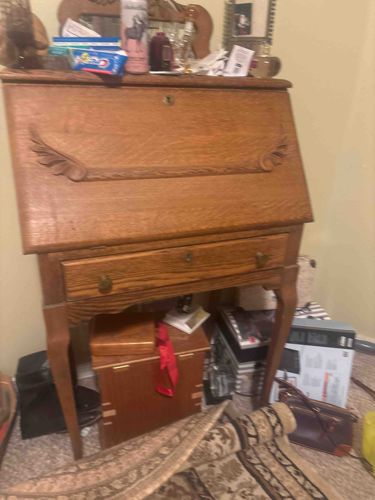
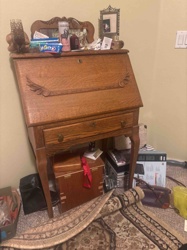
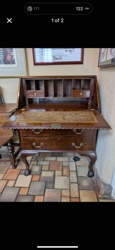
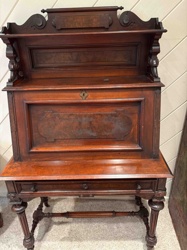
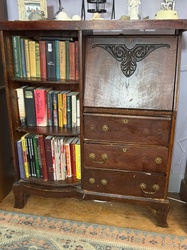
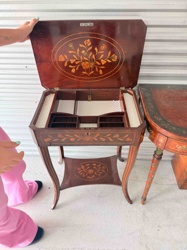
This is an antique oak secretary desk or fall-front desk, likely dating from the late 19th to early 20th century, possibly in the Arts and Crafts or Mission style, given its robust construction and visible wood grain. The desk features a rich, medium-brown finish that highlights the prominent quarter-sawn oak grain, indicative of its period and quality. The fall-front, which serves as the writing surface when lowered, is adorned with carved decorative embellishments on either side, resembling stylized wings or scrollwork, adding a touch of elegance without being overly ornate. A keyhole is visible in the center of the fall-front, suggesting it was once lockable, a common feature for securing papers and valuables. Below the fall-front, there is a single drawer with two round, possibly original, metal pulls that appear to be oxidized or tarnished brass or bronze, consistent with antique hardware. The desk is supported by four elegantly turned or shaped legs, which are wider at the top and taper towards the bottom, showcasing a subtle cabriole or tapered square form. There are no immediate signs of major structural damage such as large cracks or breaks, but typical wear and tear appropriate for its age are visible, including surface scratches, minor dings, and potential fading or inconsistencies in the finish, particularly on the top surface where items appear to have been placed. The overall construction suggests solid wood, demonstrating craftsmanship consistent with furniture built before mass production techniques became prevalent. No discernible maker's marks or signatures are visible in the provided image.
AI Appraisal Report
Upon examination of the provided images, this antique fall-front secretary desk presents as a fine example of American furniture from the late 19th to early 20th century, circa 1890-1910. The prominent medullary rays in the grain confirm it is crafted from quarter-sawn oak, a desirable feature of the period, often associated with Arts and Crafts, Mission, or late Victorian styles. The desk's form, with its shaped legs and modestly carved fall-front, is characteristic of the era's transition away from ornate Victorianism.
The overall condition appears to be good for its age, showing typical wear such as surface scratches and minor dings, which are expected and do not significantly detract from its value. The hardware, though tarnished, appears to be original. The value is influenced by the quality of the quarter-sawn oak and the functional, compact design which remains popular. Current market conditions for this type of American oak furniture are stable. Comparable secretary desks of similar quality and condition typically sell in the range of $400 to $650 at auction or in antique shops.
However, this appraisal is limited by the inability to physically inspect the item. A hands-on examination would be necessary to confirm the stability of the joinery, check for any repairs or restorations, and search for a maker's mark which could significantly increase its value. Authenticity of the finish and hardware can also only be definitively verified in person. Without provenance or physical inspection, this valuation is based on general market comparables for unmarked pieces of this style and period.