AI estimate as of August 26, 2025 · verify with a professional before acting
AI-Generated · Verify before acting
Everything on this page is generated by AI for informational purposes only. AI can make mistakes — the AI may misidentify items or misattribute them (artist, maker, brand, designer, origin, era). This is not an official valuation and should not be used for insurance, sale, tax, estate, legal, or lending purposes — or any decision requiring a certified appraisal. It is not an authoritative claim about any person, brand, or rights holder — do not share or rely on it as a factual statement about a third party. Always consult qualified professionals before making financial decisions.
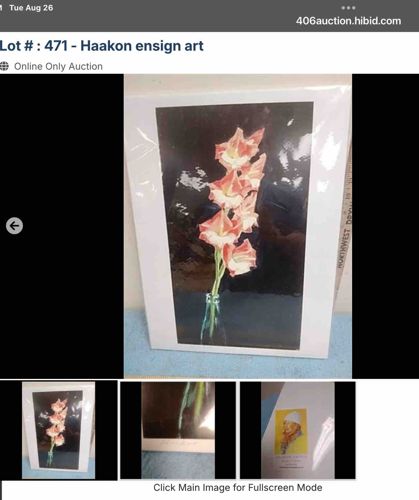
This item is an artistic print, likely a giclee or lithograph, presented with a white border, suggesting it is matted or designed with an integrated mat. The central image depicts a vibrant floral arrangement of gladiolus flowers within a clear glass vase, set against a dark background that appears to be black. The gladiolus blooms are characterized by their multi-toned petals, featuring shades of pale pink, peach, and white, with distinct darker striping or markings on some of the petals, adding depth and realism. The vase is rendered with a greenish tint, indicating the glass type or reflections, and contains visible water and stems. The print exhibits a glossy finish, possibly due to a protective layer or the type of paper used, which creates reflections visible in the photographs. The white border acts as a visual framing element, setting off the main artwork. The overall condition appears to be excellent, with no visible tears, creases, or major surface abrasions. It is presented in a protective clear plastic sleeve, which is common for art prints to prevent dust and surface damage. Based on the auction title 'Haakon ensign art', it is plausible that this print is by an artist named Haakon or is part of a series/collection attributed to someone by that name. The quality of the printing appears high, with good color saturation and detail, suggesting professional production. The style is realistic and naturalistic, focusing on the beauty of the botanical subject matter. The print is currently unframed, allowing for future customization by a purchaser. The visible text on the accompanying item on the right states 'NORTHWEST DEV', which might refer to "Northwest Development" or a similar entity, possibly related to the artist or a printing company, but this is speculative given the limited visibility.
AI Appraisal Report
Upon examining the provided images of the 'Haakon Ensign Art Print: Gladiolus Flowers in Vase,' I find the print to be in excellent condition, showing no visible tears, creases, or major surface abrasions. The glossy finish and clear protective sleeve suggest careful handling and storage. Authenticity, based solely on visual examination, appears to align with a professionally produced art print. The vibrant colors and detailed rendering of the gladiolus flowers indicate high-quality printing. The 'Haakon ensign art' title suggests an artist or series attribution, though without further information, I cannot confirm the artist's full identity or the specific printing technique (giclee vs. lithograph). The 'NORTHWEST DEV' visible on an accompanying item is intriguing but unconfirmatory.
Market conditions for unframed decorative art prints, especially floral subjects, are generally stable, driven by aesthetic appeal. Comparable works by lesser-known or decorative artists typically fetch modest prices. There's good demand for visually appealing prints for home decor. Rarity is difficult to ascertain without knowing the edition size; if it's an open edition, rarity is low. The primary impact on value is its decorative appeal, excellent condition, and professional production quality.
Limitations in authenticity verification from images alone are significant. I cannot verify the specific printing process (e.g., archival inks, paper quality), the artist's signature (if any), or the edition number. For full authentication, an in-person examination would be needed to inspect the print surface for texture, dot patterns, and the presence of any embossed marks or signatures. Provenance documentation, such as a certificate of authenticity or purchase records, would be crucial to confirm the artist's attribution and edition details. Scientific testing (e.g., ink analysis) could verify the print's age and materials but is generally not cost-effective for prints in this price range.