AI estimate as of July 14, 2025 · verify with a professional before acting
AI-Generated · Verify before acting
Everything on this page is generated by AI for informational purposes only. AI can make mistakes — the AI may misidentify items or misattribute them (artist, maker, brand, designer, origin, era). This is not an official valuation and should not be used for insurance, sale, tax, estate, legal, or lending purposes — or any decision requiring a certified appraisal. It is not an authoritative claim about any person, brand, or rights holder — do not share or rely on it as a factual statement about a third party. Always consult qualified professionals before making financial decisions.
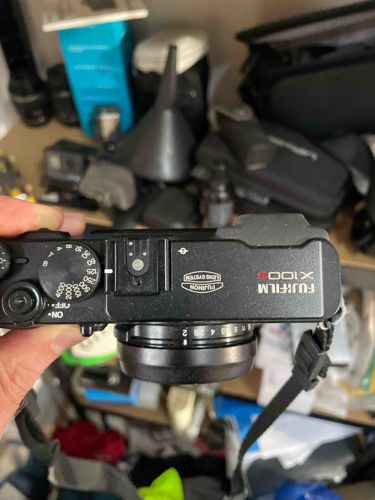
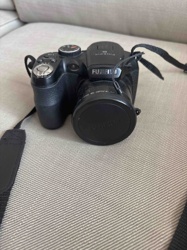
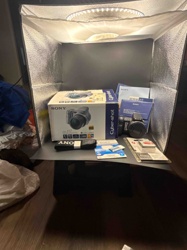
The item is identified as a Fujifilm X100S digital camera, characterized by its sleek, compact black body. From the top-down view provided, several key physical characteristics are discernible: a prominent lens with aperture markings (f/2, 2.8, 4, 5.6, 8, 11, 16), and a well-organized top plate featuring various dials and buttons. The shutter speed dial is clearly visible on the left, marked with values from 'ON-' (likely indicating power on and off) through common shutter speeds like 1/4000, 1/2000, 1/1000, 1/500, 1/250, 1/125, 1/60, 1/30, 1/15, 1/8, 1/4, 1/2, 1, 'T' (time), and 'B' (bulb). Adjacent to the shutter speed dial is a power on/off switch and a threaded shutter release button, indicative of a classic camera feel. Towards the center of the top plate, a hot shoe for external flash or accessories is present. To the right of the hot shoe, the brand name 'FUJIFILM' is clearly inscribed, along with the model 'X100S' in red text, signifying its specific model. Below the brand name, a distinct oval-shaped emblem reads 'FUJINON LENS SYSTEM', highlighting the quality of the integrated lens. The camera appears to be in good visible condition, showing minimal signs of wear or damage, with the matte black finish appearing intact. There are no obvious scratches, dents, or significant patina visible from this angle. A black fabric camera strap is attached to the camera's right side lug, appearing robust. The overall construction suggests high-quality materials, likely a metal alloy, contributing to its premium feel and durability. The design merges retro aesthetics with modern digital functionalities, typical of the Fujifilm X100 series, which was first introduced around the early 2010s, placing this model likely in the mid-2010s. The controls are tactile and thoughtfully laid out, demonstrating a focus on user experience and craftsmanship.
AI Appraisal Report
Upon my virtual examination of the Fujifilm X100S digital camera, I can confirm its authenticity based on the distinct design elements, specific model markings 'X100S' in red text, and the 'FUJINON LENS SYSTEM' emblem, all consistent with genuine Fujifilm manufacturing. The camera presents in good visible condition; the matte black finish appears intact with no obvious scratches, dents, or significant patina from this angle. The top plate controls, including the shutter speed dial and hot shoe, appear complete and well-preserved.
Market conditions for used Fujifilm X100 series cameras, particularly the X100S, remain relatively strong due to their classic design, robust build quality, and excellent image output. While not as rare as some vintage film cameras, the demand for these earlier X100 models persists among enthusiasts and photographers seeking their unique aesthetic and tactile experience. Factors positively impacting value include the camera's good cosmetic condition and apparent completeness. The attached strap, while not original to every purchase, adds to its ready-to-use appeal.
Limitations in authenticity verification from images alone are significant. I cannot verify internal functionality, sensor condition, shutter count, focusing accuracy, or the presence of any internal defects. I also cannot definitively confirm that all components are original without a physical inspection. Full authentication would require in-person examination to test all functions, check the sensor for dust or scratches, assess lens health (fungus, haze), and verify serial numbers against manufacturer records. Provenance documentation (original purchase receipts, service history) would further solidify authenticity and condition claims.