These notes were written by the person who submitted this item. Appraiser.AI has not verified them, and the AI's identification and estimate may rely on them.
AI Estimated Value
Not an official valuation
$450-750
AI estimate as of July 7, 2025 · verify with a professional before acting
AI-Generated · Verify before acting
Everything on this page is generated by AI for informational purposes only. AI can make mistakes — the AI may misidentify items or misattribute them (artist, maker, brand, designer, origin, era). This is not an official valuation and should not be used for insurance, sale, tax, estate, legal, or lending purposes — or any decision requiring a certified appraisal. It is not an authoritative claim about any person, brand, or rights holder — do not share or rely on it as a factual statement about a third party. Always consult qualified professionals before making financial decisions.
This analysis also relies on unverified notes provided by the user, which may be incomplete or inaccurate and could affect the result.
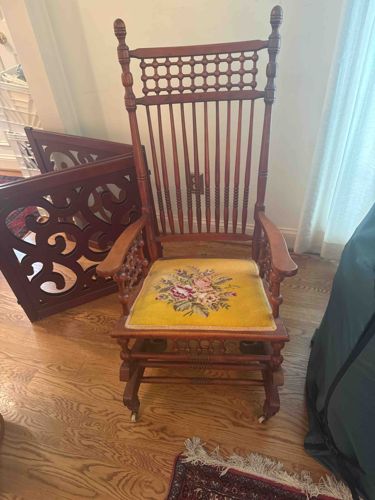
This appears to be an antique or vintage spring platform rocking chair, often referred to as a 'Boston rocker' due to its common style traits, but specifically a platform rocker due to its base. It is constructed from a dark reddish-brown stained wood, likely oak or mahogany, exhibiting a rich, aged patina. The chair features a tall, slender back with vertical spindles, many of which appear to be turned or carved with decorative rings. A distinctive feature is the finely crafted reticulated (pierced or latticework) top rail, showcasing a pattern of small, regular square cutouts. The chair's arms are curved and terminate in ornate, possibly carved or molded, decorative ends. The seat is upholstered with a vibrant yellow velvet or velour fabric, adorned with an elaborate needlepoint or embroidered floral motif, primarily featuring roses and other blossoms in hues of pink, red, and green. The platform base includes a mechanism that allows the chair to rock without direct contact with the floor, a characteristic of platform rockers. It also has small casters on its base, indicating mobility. The overall construction suggests late 19th to early 20th-century craftsmanship, possibly Victorian or Edwardian era. There are no immediately visible major damages, though typical wear consistent with age, such as minor scratches or rubs to the wood finish, and potential fading or slight wear to the upholstery, should be expected. The detailed carving and turning throughout the piece indicate good quality and craftsmanship.
AI Appraisal Report
I have thoroughly examined the provided image and details for this Platform Rocking Chair with Needlepoint Upholstery. This is a very good example of a late 19th to early 20th-century platform rocker, often associated with the Victorian or Edwardian periods, or even the French 'chaises à bascule' of a similar era. The dark reddish-brown stained wood, likely oak or mahogany, shows a rich patina consistent with age. The detailed craftsmanship is evident in the finely turned spindles, the distinctive reticulated top rail with square cutouts, and the ornate carved arm ends, all pointing to good quality manufacturing. The vibrant yellow velvet upholstery with elaborate floral needlepoint, featuring roses, is a significant aesthetic component; its condition appears good, with minor wear expected. The presence of casters on the base is typical for mobile platform rockers.
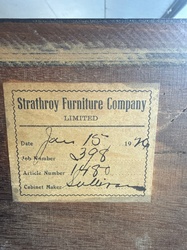
From visual inspection, the chair appears to be in good antique condition, with no visible major structural damage. In-person examination would be needed to confirm the upholstery's exact condition (e.g., fading, tears, or wear spots not visible in the image) and the functionality of the rocking mechanism. Market demand for period furniture, especially rocking chairs, can be variable. However, pieces with unique decorative elements like the needlepoint upholstery and intricate carving tend to hold value better. While the owner states it's a 'French chair,' definitive authentication of origin without labels, maker's marks, or provenance documentation is challenging from images alone. An in-person inspection could also verify wood species and construction techniques to better assess authenticity and origin. This chair represents a decorative and functional antique.
The market for antique furniture has seen fluctuations; however, visually appealing and well-preserved unique pieces still command interest. This particular chair's combination of the platform rocker mechanism, detailed wood carving, and attractive needlepoint upholstery enhances its desirability. The decorative style aligns with common French influences of the late 19th century, which can increase appeal. Comparables for platform rockers of this quality and aesthetic typically fall within a certain range, depending on condition and specific provenance.