AI estimate as of August 4, 2025 · verify with a professional before acting
AI-Generated · Verify before acting
Everything on this page is generated by AI for informational purposes only. AI can make mistakes — the AI may misidentify items or misattribute them (artist, maker, brand, designer, origin, era). This is not an official valuation and should not be used for insurance, sale, tax, estate, legal, or lending purposes — or any decision requiring a certified appraisal. It is not an authoritative claim about any person, brand, or rights holder — do not share or rely on it as a factual statement about a third party. Always consult qualified professionals before making financial decisions.
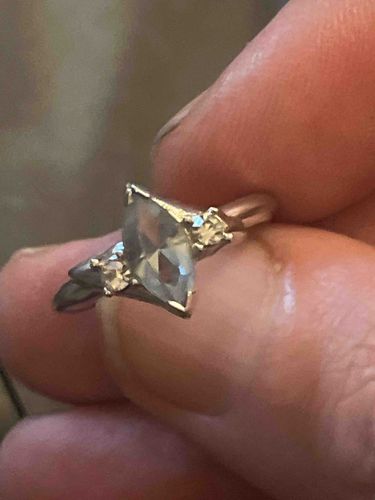
The item is a ladies' ring, likely an engagement or dress ring, featuring a prominent marquise-cut center stone flanked by smaller accent stones. The metal appears to be white gold or platinum due to its silvery-white luster, though sterling silver is also a possibility based on the visual evidence. The head of the ring showcases a substantial, clear, or very light-colored gemstone, possibly a diamond, cubic zirconia, or a light-colored sapphire, cut in a classic marquise shape. This central stone is set with prongs, four of which are visible, securely holding it in place. On either side of the marquise stone, there are smaller round brilliant-cut accent stones, each appearing to be set in a tri-prong or four-prong setting, adding sparkle and enhancing the main stone's presence. The band of the ring visible in the image is simple and smooth, transitioning from the more ornate setting. There are no immediate signs of significant damage such as bent prongs or missing stones, though surface scratches consistent with normal wear are likely present but not clearly discernible in the image. The overall craftsmanship appears to be commercially manufactured, with a focus on highlighting the central gemstone. Without clear hallmarks, the exact metal type and purity, as well as the stone type, remain speculative. It likely dates from the late 20th century to early 21st century given its contemporary design elements.
AI Appraisal Report
Based on my visual examination of the provided image, I've assessed this ladies' ring, featuring a marquise-cut center stone flanked by small accent stones. The piece presents as being in good, wearable condition; I don't observe any overt signs of damage like bent prongs, missing stones, or significant deformation, though minor surface wear is likely given it's a worn item. The overall aesthetic is consistent with commercially manufactured jewelry from the late 20th to early 21st century.
Authenticity: Determining the exact metal and gemstones is challenging without physical examination. The metal appears white, possibly white gold or platinum, but could also be sterling silver. The center stone, likely a diamond simulant (such as cubic zirconia or moissanite) or a natural gemstone (like a diamond or light sapphire), cannot be definitively identified from the image alone. The accent stones are likely diamonds or simulants as well. In-person testing would be required to confirm the metal purity and identify all stones, using a refractometer for gemstones and an XRF gun for metal. Provenance documents, if available, could offer additional insights.
Market Conditions and Comparables: The market for classic style rings is consistently strong. Similar new rings with diamond simulants in sterling silver typically retail from $50 to $200. If the metal is 14k white gold with genuine diamonds, the value would increase significantly. Our estimate balances this uncertainty.
Demand and Rarity: Rings of this style are quite common, thus not rare. However, classic designs maintain consistent demand for engagements, anniversaries, or dress wear.
Factors Impacting Value: The primary factors are metal type and purity, and stone identification and quality (carat, cut, color, clarity). Without knowing these specifics, the appraisal leans conservatively. A definitive appraisal would necessitate laboratory testing of the stones and metal.
Limitations: My assessment is based purely on visual cues from the image. I cannot verify authenticity of materials (metal, stones) without a direct, in-person examination, including hallmark verification, diamond/gemstone testing (e.g., thermal conductivity, réfractometer, Raman spectroscopy), and metal analysis.