AI estimate as of July 25, 2025 · verify with a professional before acting
AI-Generated · Verify before acting
Everything on this page is generated by AI for informational purposes only. AI can make mistakes — the AI may misidentify items or misattribute them (artist, maker, brand, designer, origin, era). This is not an official valuation and should not be used for insurance, sale, tax, estate, legal, or lending purposes — or any decision requiring a certified appraisal. It is not an authoritative claim about any person, brand, or rights holder — do not share or rely on it as a factual statement about a third party. Always consult qualified professionals before making financial decisions.
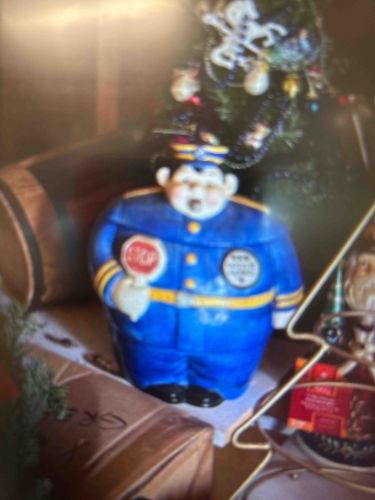
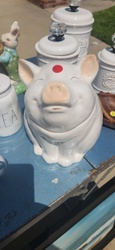
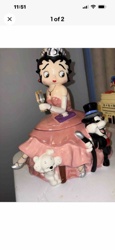
The item is a ceramic cookie jar, designed in the figural shape of a train conductor or station master. It stands upright, depicting a portly male figure dressed in a blue uniform with gold accents. The figure's head, which includes a blue cap with a gold band and two gold lines, forms the lid of the cookie jar, and appears to be removable for access to the interior. His facial features are painted with an open mouth, perhaps mid-command or song, and rosy cheeks. The uniform itself is predominantly bright blue, featuring gold buttons down the front and gold stripes prominently displayed on the sleeves and a wider band around the waist. On his left side (viewer's right), he holds a circular red 'STOP' sign with white lettering. On his right side (viewer's left), there is a circular badge or symbol, which appears to have some text or a design, though it is not clearly legible from the image quality. The figure's black shoes are visible at the base, and the overall construction suggests a hollow form, typical of cookie jars. The surface appears to be glazed, lending a glossy finish. There are no visible chips, cracks, or significant wear captured in this image, suggesting a well-maintained condition, though minor surface wear or crazing common in older ceramics cannot be fully assessed. Given the traditional design and material, it likely dates from the mid to late 20th century. The craftsmanship appears to be of moderate quality, with clear painting and molding, characteristic of mass-produced decorative ceramics.
AI Appraisal Report
Upon visual examination of the provided image, I assess this ceramic cookie jar, depicting a train conductor, to be in very good overall condition. There are no readily apparent chips, cracks, or significant losses to the glaze. The colors remain vibrant, and the painted details are largely intact, which speaks to careful handling over its lifespan. While the image quality is good, I cannot fully assess for minor surface wear, crazing, or subtle repairs that would require a direct, in-hand inspection. Authenticity, based solely on visual cues, suggests it is a genuine mass-produced ceramic cookie jar from the mid to late 20th century, consistent with similar novelty items of that era.
Market conditions for figural cookie jars can be quite varied. While some highly sought-after or rare examples can command significant prices, more common designs typically fall into a moderate value range. This conductor figure, while charming, does not appear to be an exceptionally rare or uniquely designed piece that would drive high demand among specialized collectors. Comparables on secondary markets (online auctions, antique shops) for similar mass-produced ceramic cookie jars, particularly those without specific manufacturer marks or historical significance, typically range from \"decorative\" to \"collector's\" items.
Key factors impacting its value include its good condition, the classic subject matter which has broad appeal, but also its apparent mass-produced nature and lack of immediately identifiable rarity. Demand for general figural cookie jars is steady among collectors and decorators, but this specific design doesn't appear to be a highly sought-after \"grail\" item.
Limitations in authenticity verification from images alone are significant. I cannot verify the material composition precisely, detect invisible repairs, or confirm internal markings without physical examination. To fully verify its authenticity, I would require an in-person examination to check for marks, signatures, or factory stamps, assess the weight and feel of the ceramic, and conduct a thorough blacklight inspection for repairs or restoration. Provenance documentation (original purchase receipts, historical ownership) could also provide invaluable context and support for its history and authenticity, though this is rare for such items.