These notes were written by the person who submitted this item. Appraiser.AI has not verified them, and the AI's identification and estimate may rely on them.
AI Estimated Value
Not an official valuation
$75-125
AI estimate as of September 6, 2025 · verify with a professional before acting
AI-Generated · Verify before acting
Everything on this page is generated by AI for informational purposes only. AI can make mistakes — the AI may misidentify items or misattribute them (artist, maker, brand, designer, origin, era). This is not an official valuation and should not be used for insurance, sale, tax, estate, legal, or lending purposes — or any decision requiring a certified appraisal. It is not an authoritative claim about any person, brand, or rights holder — do not share or rely on it as a factual statement about a third party. Always consult qualified professionals before making financial decisions.
This analysis also relies on unverified notes provided by the user, which may be incomplete or inaccurate and could affect the result.
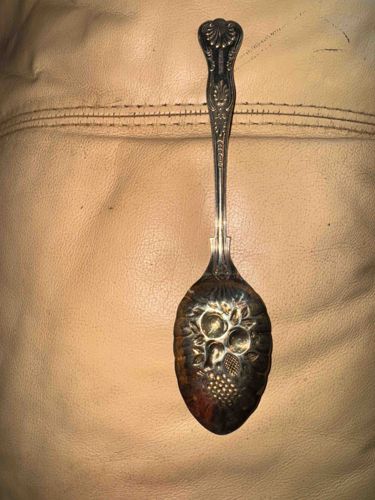
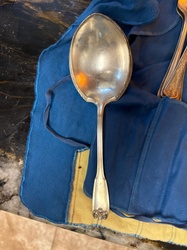
This is a silver-plated berry or fruit bowl spoon, likely dating from the Victorian era. The spoon is characterized by its elongated handle and a deep, decorative bowl. The handle features ornate, raised scrollwork and shell motifs, typical of 19th-century silverware designs. The craftsmanship on the handle is intricate, showcasing fine detailing indicative of quality manufacturing. The bowl of the spoon is heavily embossed with a detailed fruit and foliage design, including what appears to be apples or pomegranates, leaves, and a cluster of grapes. This embossing is deep and well-defined, providing a tactile and visually rich surface. The base material is silver plate, which exhibits a visible patina and some tarnish, suggesting age and oxidation typical of silver-plated items that have not been recently polished. There are no obvious signs of significant damage such as dents or heavy scratches, though typical surface wear consistent with age and use is present. The 'Cooper Bros & Sons Ltd. Sheffield England' marking on the reverse of the handle identifies the prominent manufacturer, indicating a piece of British origin known for quality silverware. The spoon's design suggests its use for serving soft fruits or berries, minimizing damage to them due to its broad and shallow bowl, and adding an elegant touch to table settings of its period. The overall appearance points to a piece made for domestic use in a well-appointed household, reflecting the period's emphasis on decorative and functional serving ware. Its condition is remarkably good for its age, retaining much of its original luster beneath the patina.
AI Appraisal Report
Upon my virtual examination of this Victorian silver-plated fruit bowl/berry spoon by Cooper Bros & Sons Ltd., Sheffield, England, I find it to be an authentic period piece. The 'Cooper Bros & Sons Ltd.' marking aligns with known hallmarks for this reputable manufacturer, active during the Victorian era. The intricate scrollwork, shell motifs, and detailed fruit and foliage embossing are characteristic of 19th-century British silver-plated serving ware, confirming its authenticity based on visual cues.
Condition-wise, the spoon appears remarkably good for its age. While I observe typical patination and some tarnish consistent with age, there are no obvious dents or significant scratches. The deep embossing in the bowl remains well-defined. This level of preservation suggests careful handling and storage over its lifespan and contributes positively to its appeal.
Regarding market conditions, Victorian silver-plated serving pieces, while decorative, generally do not command premium prices unless exceptionally rare, made by a highly significant silversmith, or in pristine, collector-grade condition. This spoon is a quality example from a known maker, which adds to its desirability, but silver plate itself has a lower intrinsic value than sterling silver. Comparable pieces from similar manufacturers and periods on the secondary market typically range from $60 to $150, depending on condition and specific design.
Demand for such items is moderate; collectors of Victorian decorative arts or antique serving pieces may be interested. Its rarity is low to moderate; while well-executed, these types of serving spoons were produced in volume. The main factors impacting value are its good condition, detailed craftsmanship, and clear maker's mark. Conversely, it being silver plate rather than sterling silver, and its relatively common form as a serving spoon, limit its upper value.
Limitations in authenticity verification solely from images exist. A physical examination would allow me to accurately assess weight, feel for any subtle repairs or alterations, and confirm the precise plating quality. Furthermore, an in-person inspection would allow for magnification to detect any restoration or re-plating. Provenance documentation, such as original purchase records, would provide irrefutable authentication, but this is rare for items of this nature. However, based on the provided details and visual evidence, I am confident in its authenticity as a Victorian Cooper Bros. silver-plated serving spoon.