AI Appraisal Estimate

AI-generated estimates · not official valuations

From the user

What was submitted

Photo and notes provided by the user — not generated by AI

Submitted item photo
Submitted photo · May 23, 2026

User's notes

what can you tell me about this

AI analysis below

AI appraisal

AI analysis & estimate

AI-Generated · Verify before acting

Everything below is generated by AI for informational purposes only. AI can make mistakes — the AI may misidentify items or misattribute them (artist, maker, brand, designer, origin, era). This is not an official valuation and should not be used for insurance, sale, tax, estate, legal, or lending purposes — or any decision requiring a certified appraisal. It is not an authoritative claim about any person, brand, or rights holder — do not share or rely on it as a factual statement about a third party. Always consult qualified professionals before making financial decisions.

Note

This analysis also relies on unverified notes provided by the user, which may be incomplete or inaccurate and could affect the result.

Read the full disclaimer

AI Identification

·Not independently authenticated·Verify before acting

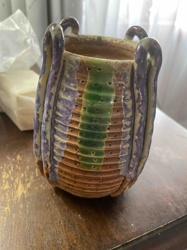
Base of a Handcrafted Ceramic Vessel

Ceramics & Decorative Arts

AI Estimated Value

·Not an official valuation·Verify before acting

$150 - $250

As of May 23, 2026

AI Item Analysis

·AI can make mistakes·Verify before acting
This is a detailed view of the underside or base of a handcrafted tripod ceramic vessel. The piece is constructed from a reddish-brown earthenware or terracotta clay body, which is visible where the glaze has worn or was intentionally left unapplied on the foot rim. The base features three short, tapered tripod legs, which are partially visible at the bottom of the frame, finished in a contrasting pale yellowish-green glaze. The circular base itself shows circular wiped patterns, suggesting it was hand-turned on a wheel or smoothed manually. The exterior rim is decorated with a mottled, metallic-sheen glaze that transitions between shades of deep purple, grey, and iridescent copper. This type of glaze is often associated with raku firing or specific luster glaze techniques, which create unique, non-uniform surface textures. In terms of condition, there is significant surface abrasion and pitting concentrated on the contact points of the base, indicating a period of use or shelf wear. There are no visible maker's marks or signatures on the underside, which is common for folk art or studio pottery. The style suggests a mid-20th-century to contemporary studio piece, likely leaning towards a rustic or brutalist aesthetic given the heavy glaze application and raw clay texture.
AI Appraisal Report

·AI can make mistakes·Verify before acting
I have carefully examined the provided images of this handcrafted tripod ceramic vessel. The piece exhibits characteristics consistent with mid-to-late 20th-century studio pottery, specifically those influenced by the Brutalist or experimental Raku movements. The reddish-brown earthenware body is of good quality, and the iridescent metallic luster glaze—likely achieved through a reduction firing process—is professionally applied, showing desirable variations in copper and violet hues. The condition is fair to good; the significant surface abrasion and pitting on the base are expected signs of age and shelf wear for a piece of this type, though the lack of a maker's mark does impact its collectibility and market ceiling. The current market for anonymous studio pottery remains steady, with increased demand for Brutalist aesthetics among interior designers. Comparable unsigned tripod vessels of this scale and glaze quality typically fetch between $100 and $300 at specialized decorative arts auctions. Rarity is considered moderate, as while the glaze effects are unique to the firing, the form is a known studio trope. Several factors limit a definitive valuation. Without a physical inspection, I cannot confirm the presence of structural hairline cracks obscured by the heavy glaze or the exact stability of the tripod legs. To fully authenticate this piece or potentially attribute it to a specific studio, a physical examination of the 'wiped' base patterns and tactile weight comparison is necessary. Provenance documentation, such as a gallery receipt or exhibition history, would be required to elevate this piece from 'anonymous studio work' to a named collectible, which could double the current estimate. Further scientific testing like thermoluminescence is not recommended as the cost would exceed the item's likely market value.

Get your items appraised

Instant estimates of your treasures with AI-powered appraisals

Browse More Appraisals