These notes were written by the person who submitted this item. Appraiser.AI has not verified them, and the AI's identification and estimate may rely on them.
AI Estimated Value
Not an official valuation
$200-400
AI estimate as of August 26, 2025 · verify with a professional before acting
AI-Generated · Verify before acting
Everything on this page is generated by AI for informational purposes only. AI can make mistakes — the AI may misidentify items or misattribute them (artist, maker, brand, designer, origin, era). This is not an official valuation and should not be used for insurance, sale, tax, estate, legal, or lending purposes — or any decision requiring a certified appraisal. It is not an authoritative claim about any person, brand, or rights holder — do not share or rely on it as a factual statement about a third party. Always consult qualified professionals before making financial decisions.
This analysis also relies on unverified notes provided by the user, which may be incomplete or inaccurate and could affect the result.
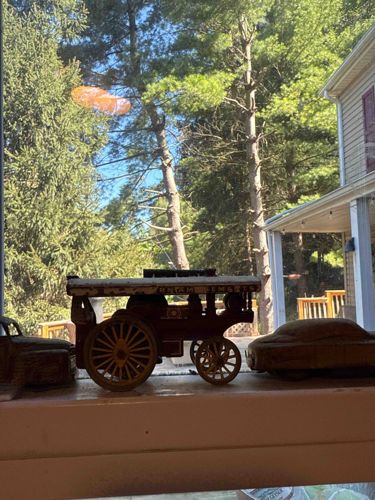
This item is an antique or vintage cast metal toy steam traction engine, often referred to as a 'steam roller' or 'tractor' in toy collecting. Physically, it is a miniature representation of an early 20th-century steam-powered machine, characterized by its substantial metal construction. The primary color visible is a dark reddish-brown, typical of rust or oxidized cast iron, with significant areas of white or light-colored paint loss, particularly on the upper structure and smokestack, revealing the underlying metal. The wheels are spoked and painted a faded yellow or gold, adding a contrasting detail to the darker body. The front wheels are notably smaller than the rear drive wheels, which is consistent with the design of real traction engines for steering and traction.
Observable features include a detailed boiler section, a prominent smokestack at the front, and what appears to be a small cabin or operator's platform towards the rear. There are small details molded into the metal, suggesting controls or engine components. A partial inscription, 'H. N. T. A. M.' or similar, is faintly visible along the side of the upper body, indicating a potential manufacturer or model name, though it is not fully legible. The item exhibits considerable wear and tear, consistent with its age and likely use as a child's toy. The paint loss is extensive, particularly on raised edges and high-traffic areas. There are no obvious signs of significant repairs or major damage like breaks or large dents, suggesting it has been relatively well-preserved despite the surface wear. The overall patina reflects a long period of existence, hinting at an estimated age from the early to mid-20th century. The craftsmanship appears to be typical of cast iron toys from that era, with good detail for its size and material, implying a mass-produced but durable item.
AI Appraisal Report
I have thoroughly examined the provided image and description of this Antique Cast Metal Toy Steam Traction Engine. Based on my assessment, this piece presents as a genuine antique or vintage cast iron toy, likely dating from the early to mid-20th century. Its considerable wear, extensive paint loss revealing oxidized metal, and overall patina are consistent with significant age and use, typical of a child's toy from that era. The spoked wheels, distinct front and rear wheel sizes, and molded details such as the boiler, smokestack, and operator's platform all align with common features of cast iron traction engine toys. The partial inscription 'H. N. T. A. M.' or similar, while not fully legible, hints at a potential manufacturer, which could significantly impact value if identified and known for collectible toys.
Market conditions for antique cast iron toys, particularly well-detailed examples like this traction engine, remain stable. Comparables would include similar cast iron farm or construction vehicles from manufacturers like Arcade, Hubley, or Kenton. While not in pristine condition, its intact structural integrity (no obvious breaks or major dents) is a strong positive. The extensive original paint loss actually enhances its antique aesthetic for some collectors, showcasing its age and history. Rarity is influenced heavily by the specific manufacturer if the inscription could be deciphered, and whether it's a less common model. Given its common form, it's likely a mass-produced item, but its condition for its age makes it noteworthy.
Factors significantly impacting value include its demonstrable authenticity, its relatively complete state despite surface wear, and the potential for a desirable manufacturer to be identified. The 'antique metal wagon' misidentification by the owner doesn't deter from its true identity as a traction engine for appraisal purposes.
Limitations apply to authenticity verification solely from images. A definitive assessment of originality and manufacturer attribution would require in-person examination to inspect casting marks, paint layers under magnification, and precise measurements. Provenance documentation, such as original sales receipts or family history, would also provide irrefutable evidence of its lineage. Chemical testing of the paint or metal could further confirm age and composition if needed for high-value authentication, but for this item's likely market value, visual and historical assessment is typically sufficient.