AI Appraisal Estimate

AI-generated estimates · not official valuations

From the user

What was submitted

Photo and notes provided by the user — not generated by AI

Submitted item photo
Submitted photo · June 8, 2026

User's notes

Fine Art. Print

AI analysis below

AI appraisal

AI analysis & estimate

AI-Generated · Verify before acting

Everything below is generated by AI for informational purposes only. AI can make mistakes — the AI may misidentify items or misattribute them (artist, maker, brand, designer, origin, era). This is not an official valuation and should not be used for insurance, sale, tax, estate, legal, or lending purposes — or any decision requiring a certified appraisal. It is not an authoritative claim about any person, brand, or rights holder — do not share or rely on it as a factual statement about a third party. Always consult qualified professionals before making financial decisions.

Note

This analysis also relies on unverified notes provided by the user, which may be incomplete or inaccurate and could affect the result.

Read the full disclaimer

AI Identification

·Not independently authenticated·Verify before acting

Rural Hay Wagon Harvest Print

Fine Art Prints

AI Estimated Value

·Not an official valuation·Verify before acting

$45 - $85

As of June 8, 2026

AI Item Analysis

·AI can make mistakes·Verify before acting
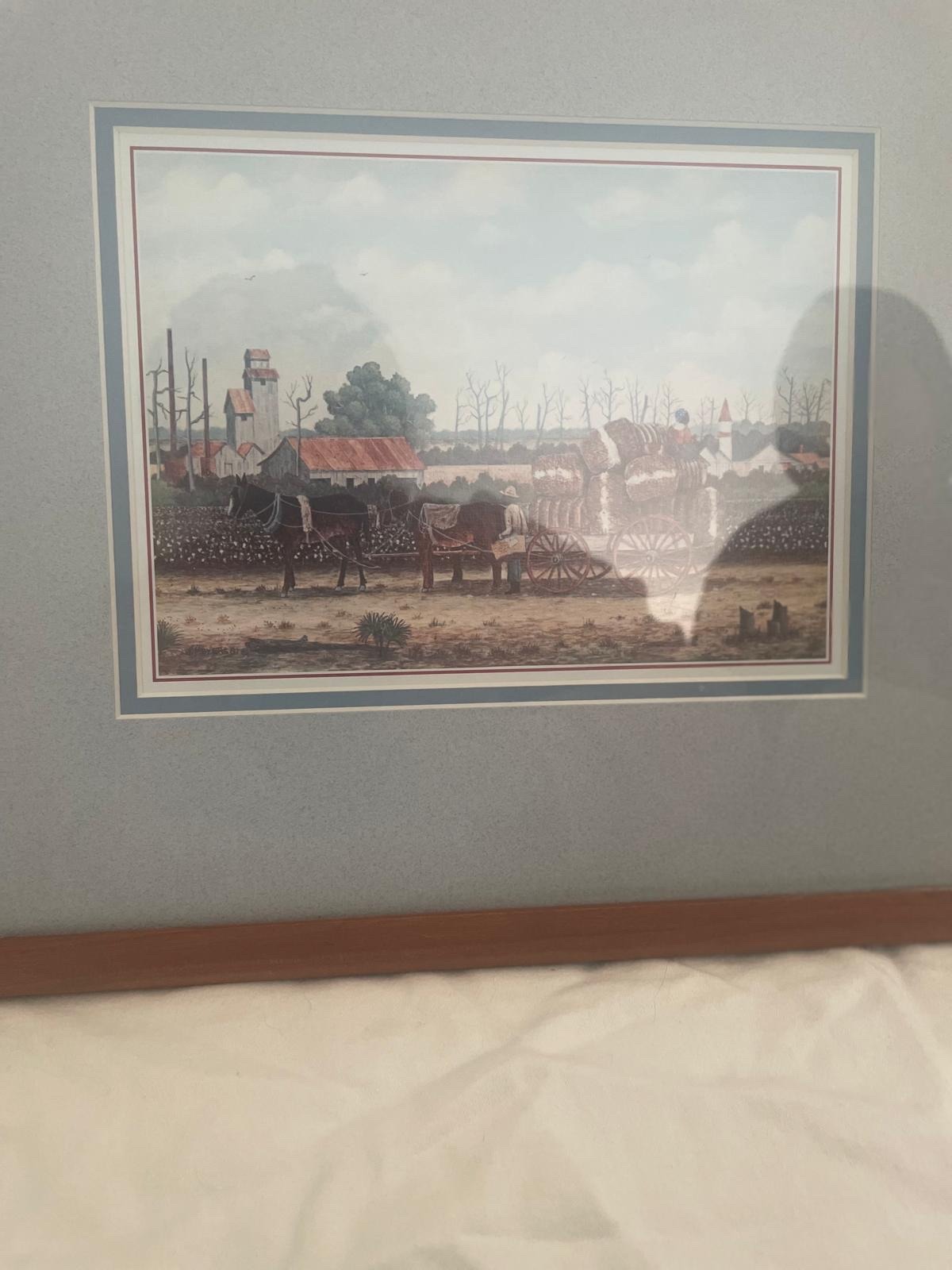
This item is a framed fine art print depicting a pastoral, rural harvest scene. The central focus of the artwork is a pair of draft horses hitched to a wooden wagon heavily laden with large, round hay bales. A figure in a wide-brimmed hat stands near the horses, while another figure is seated atop the hay. The background features a rustic industrial or agricultural complex, including a silo and buildings with rusted corrugated roofs, set against a line of bare trees and a pale, overcast sky. The color palette is composed of earthy tones—browns, tans, and muted greens—accentuated by the rusty red of the rooftops. The print is housed in a professional triple-matting display, featuring a wide light-blue outer mat, a thin white middle mat, and a red inner accent mat. The assembly is protected by glass and encased in a simple, honey-toned wooden frame. Regarding condition, the print appears well-preserved within the frame, showing no immediate signs of foxing or moisture damage, though there is a prominent reflection on the glass from the photography. The style is representative of late 20th-century Americana or folk-influence realism. No clear artist signature is visible in the provided image, but the level of detail in the wagon wheels and architectural elements suggests a skilled illustrator or painter common in heritage-themed residential decor.
AI Appraisal Report

·AI can make mistakes·Verify before acting
I have conducted a visual examination of the framed fine art print depicting a rural hay harvest scene. The work is a decorative reproduction print, likely an offset lithograph, representative of late 20th-century Americana. The composition demonstrates competent technical skill in its depiction of the wagon and draft horses, typical of commercial heritage art produced for the residential decor market. The condition of the paper appears stable with no visible foxing, though the triple-matting and glass prevent a tactile inspection of the substrate for acidity or hidden tape stains. The current market for unsigned, decorative rural prints is saturated. Value is primarily driven by the 'ready-to-hang' appeal rather than investment-grade fine art rarity. Comparables for such pieces in estate sales and secondary markets typically range between $40 and $100 depending on the quality of the frame. The professional triple-matting adds modest value to the physical presentation but does not elevate the inherent value of the print itself. Demand for Americana remains steady for interior design purposes but has seen a decline from its peak in the late 1990s. Critically, this appraisal is based on photographic evidence alone. Without a physical inspection, I cannot confirm the printing method (e.g., giclée vs. mass-produced lithograph), the presence of a hidden signature under the mat, or the archival quality of the materials used. A full authentication would require removing the print from the frame to check for watermarks, plate marks, or artist notations on the verso, and verifying provenance through original gallery receipts. For high-value verification, microscopic analysis would be necessary to rule out digital pixelation.

Get your items appraised

Instant estimates of your treasures with AI-powered appraisals

Browse More Appraisals