From the user

What was submitted

Photo and notes provided by the user — not generated by AI

Submitted item photo
Submitted photo · May 15, 2026

User's notes

No additional notes provided.

AI analysis below

AI appraisal

AI analysis & estimate

AI-Generated · Verify before acting

Everything below is generated by AI for informational purposes only. AI can make mistakes — the AI may misidentify items or misattribute them (artist, maker, brand, designer, origin, era). This is not an official valuation and should not be used for insurance, sale, tax, estate, legal, or lending purposes — or any decision requiring a certified appraisal. It is not an authoritative claim about any person, brand, or rights holder — do not share or rely on it as a factual statement about a third party. Always consult qualified professionals before making financial decisions.

Read the full disclaimer

AI Identification

·Not independently authenticated·Verify before acting

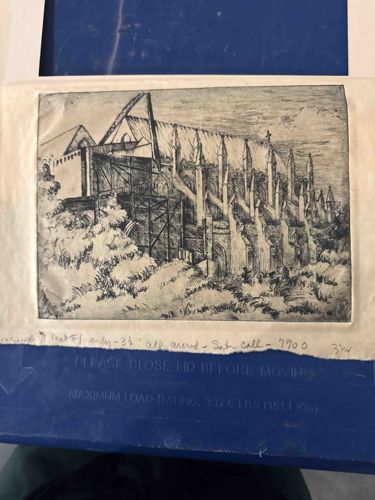
Original Architectural Etching of a Gothic Cathedral under Construction

Fine Art - Prints & Works on Paper

AI Estimated Value

·Not an official valuation·Verify before acting

$400 - $700

As of May 15, 2026

AI Item Analysis

·AI can make mistakes·Verify before acting
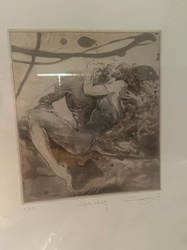
This item is a monochrome intaglio print, specifically an etching or drypoint, depicting the lateral view of a Gothic-style cathedral featuring heavy scaffolding and a crane, suggesting an architectural study of construction or restoration. The print is executed on a rectangular sheet of off-white, textured wove paper. Key physical characteristics include the fine, linear hatched lines used to define the flying buttresses, spires, and skeletal scaffolding structure. The composition utilizes deep blacks and mid-tone grays to create a sense of depth and volume. Notable condition issues are present, including significant undulation or buckling of the paper, particularly visible on the left side, and slight discoloration/toning along the margins consistent with age. There is faint handwritten notation in pencil along the bottom edge, including references like '3 1/2 all around' and 'Sat call - 7900', which appear to be framer's notes or cataloging instructions rather than an artist's signature. The style and subject matter are characteristic of the early-to-mid 20th-century architectural revivalist movement. The high level of detail in the stonework and the complex rendering of the scaffolding demonstrate a skilled hand and sophisticated understanding of perspective and structural engineering. No clear maker's mark or signature is visible in the provided image within the plate mark.
AI Appraisal Report

·AI can make mistakes·Verify before acting
I have completed a visual inspection of this architectural etching depicting a Gothic Cathedral under construction. The print exhibits technical proficiency in the intaglio process, utilizing sophisticated cross-hatching to render complex scaffolding and structural masonry. Stylistically, the work aligns with the early-to-mid 20th-century architectural revivalists, such as John Taylor Arms or Joseph Pennell, though the absence of a visible signature within the plate or on the margin suggests it may be a proof or an unsigned edition. The condition is fair to good; while the ink remains stable, the paper shows significant undulation and cockling, likely due to improper mounting or humidity exposure. Discoloration along the edges further indicates oxidative toning from acidic framing materials. The market for unsigned 20th-century architectural prints is stable but niche, typically appealing to collectors of industrial or sacred architecture. Comparable signed works by known etchers of this period fetch $1,500+, but without a definitive attribution, the value is primarily based on aesthetic and decorative merit. This valuation is limited by the digital nature of the inspection. To confirm this appraisal, I would require an in-person examination to verify the watermark, check for a signature obscured by the matting, and assess the depth of the plate mark. Provenance documentation or a gallery bill of sale would be necessary to attribute the work to a specific master. Until such evidence is provided, it must be treated as 'attributed to' or 'school of' the period.

Get your items appraised

Instant estimates of your treasures with AI-powered appraisals

Browse More Appraisals