These notes were written by the person who submitted this item. Appraiser.AI has not verified them, and the AI's identification and estimate may rely on them.
AI Estimated Value
Not an official valuation
$3,000 - $5,000
AI estimate as of October 12, 2025 · verify with a professional before acting
AI-Generated · Verify before acting
Everything on this page is generated by AI for informational purposes only. AI can make mistakes — the AI may misidentify items or misattribute them (artist, maker, brand, designer, origin, era). This is not an official valuation and should not be used for insurance, sale, tax, estate, legal, or lending purposes — or any decision requiring a certified appraisal. It is not an authoritative claim about any person, brand, or rights holder — do not share or rely on it as a factual statement about a third party. Always consult qualified professionals before making financial decisions.
This analysis also relies on unverified notes provided by the user, which may be incomplete or inaccurate and could affect the result.
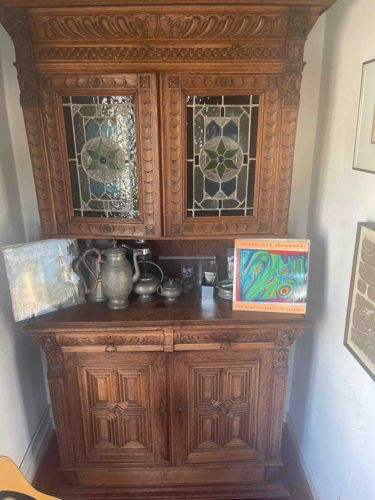
This is a substantial antique display cabinet, likely constructed from solid oak, given its rich, medium-brown hue and visible wood grain. The piece exhibits an impressive level of detailed carving throughout, indicative of a high-quality, handcrafted item. Physically, it presents as a two-part construction: a larger base unit with a cabinet and a narrower, recessed upper hutch or display section. The overall height appears significant, possibly standing over 6 feet tall. The upper section features two doors, each inlaid with a stained-glass panel. These panels display a geometric, star-like pattern in shades of green, blue, and clear textured glass, surrounded by lead cames. The wood framing these panels is heavily carved with foliate or scroll motifs, and vertical pilasters on either side are also deeply carved. The top of the cabinet is crowned with a robust, ornate pediment featuring undulating carved designs. The lower base cabinet consists of two doors with deeply carved geometric, possibly relief-carved, panel designs that resemble early Baroque or Renaissance Revival styles. There appears to be a small pull or handle between the two lower doors, and potentially small drawers above them, though this is not entirely clear. The condition appears good for an antique, with a noticeable patina consistent with age and use. There are no overt signs of damage, major repairs, or significant wear visible, although closer inspection would be required to identify minor abrasions or nicks. The intricate carvings and stained glass suggest a late 19th to early 20th-century European origin, possibly French or German due to the style of carving. The craftsmanship overall is robust and highly decorative.
AI Appraisal Report
Having closely examined the provided image and information, this Carved Oak Display Cabinet with Stained Glass Panels presents as a significant and well-crafted antique. The robust oak construction, intricate carving, and original stained-glass panels strongly suggest a late 19th to early 20th-century European origin, likely French or German, consistent with Renaissance Revival or early Baroque styles. The overall condition appears surprisingly good for its age, displaying a rich patina without overt signs of damage or major repairs. This excellent presentation enhances its market appeal.
Market conditions for substantial, highly decorative antique furniture remain somewhat niche, but pieces of this quality with original features, such as the elaborate carvings and intact stained glass, command respectable valuations. Comparables would include similar period display cabinets, especially those with artistic elements like stained glass or extensive hand-carving. The 'Antique Bar' designation, if it functions as one (which isn't clear from the image), could slightly broaden its appeal.
Demand for such statement pieces is driven by collectors and interior designers seeking unique, historically rich items. Its rarity is moderately high due to the detailed craftsmanship and likely custom-built nature. Factors positively impacting value include the substantial size, the intricate and original stained glass, and the impressive level of carving. The apparent good condition also adds significant value.
However, it's crucial to note the limitations of this appraisal due to visual examination only. Without a physical inspection, I cannot confirm the structural integrity of the oak, detect subtle repairs, assess the condition of the stained-glass leading, or verify the authenticity of all components (e.g., whether handles or interior fittings are original). In-person examination would allow for a thorough assessment of interior construction, wood type authentication, and evaluation of any minor defects not visible in images. Provenance documentation, if available, would further solidify its authenticity and potentially its historical value.