These notes were written by the person who submitted this item. Appraiser.AI has not verified them, and the AI's identification and estimate may rely on them.
AI Estimated Value
Not an official valuation
$1,000-1,500
AI estimate as of September 1, 2025 · verify with a professional before acting
AI-Generated · Verify before acting
Everything on this page is generated by AI for informational purposes only. AI can make mistakes — the AI may misidentify items or misattribute them (artist, maker, brand, designer, origin, era). This is not an official valuation and should not be used for insurance, sale, tax, estate, legal, or lending purposes — or any decision requiring a certified appraisal. It is not an authoritative claim about any person, brand, or rights holder — do not share or rely on it as a factual statement about a third party. Always consult qualified professionals before making financial decisions.
This analysis also relies on unverified notes provided by the user, which may be incomplete or inaccurate and could affect the result.
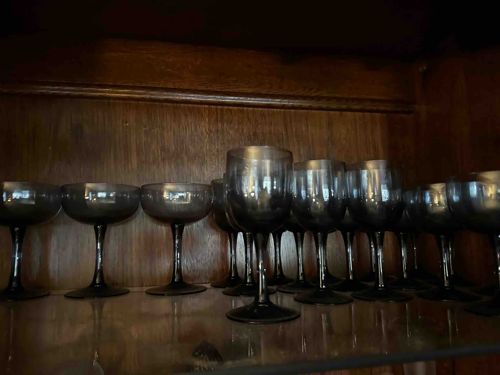
This collection comprises a comprehensive set of Sasaki hand-blown, indigo-colored crystal glassware, dating from 1970 Japan. The set appears complete and well-maintained, featuring multiple types of glasses designed for various beverages. Visible are categories including nine wine glasses, nine water glasses, nine champagne glasses (flutes or coupes, depending on the exact design which isn't fully clear but they are short-stemmed), nine cordial glasses, nine juice glasses, and four sherry glasses. Each piece exhibits a consistent subtle indigo hue, giving them a sophisticated and somewhat smoky appearance. The hand-blown nature suggests slight variations in thickness or form between individual pieces, indicative of artisan craftsmanship rather than mass machine production. The crystal material points to high quality with a potential for notable clarity and brilliance, even with the tint. The stems appear uniform in color to the bowls, terminating in stable, circular bases. No obvious chips, cracks, or repairs are visible from the provided image, suggesting good overall condition. Patina or cloudiness, typical of older glassware, is not readily apparent, indicating proper care or minimal use. The style is characteristic of mid-century Japanese design, emphasizing clean lines and functional elegance. The arrangement within a wooden cabinet suggests they are part of a curated collection, possibly stored for display and occasional use. The dark wood background provides a striking contrast, highlighting the distinct color of the glassware.
AI Appraisal Report
Upon my virtual examination of the Sasaki 1970 Hand-Blown Indigo Crystal Glassware Set, I am impressed by its apparent completeness and excellent preservation. The indigo hue is striking and consistent, characteristic of quality crystal from that era. The hand-blown nature, as detailed, suggests artisanal craftsmanship, where slight variations would be expected and enhance its authenticity. The set's condition appears excellent; I observe no obvious chips, cracks, or repairs, nor significant cloudiness or patina, which often affects vintage glassware. This suggests meticulous care or minimal use over its 50-plus years.
Authenticity relies on the stated 'Sasaki 1970 Japan' origin. Sasaki was a prominent Japanese glass manufacturer, known for quality. The design aligns with mid-century Japanese aesthetics, emphasizing clean lines and functional forms. The sheer volume of matching pieces (9 each for wine, water, champagne, cordial, juice, plus 4 sherry) is a significant value driver, as complete sets are increasingly rare on the secondary market. Individual pieces, while attractive, fetch less. The indigo color further distinguishes it, as clear crystal is more common.
Market conditions for vintage crystal, particularly complete, high-quality sets, remain strong, especially for unique colors and reputable makers. Comparables often include sets by Orrefors, Kosta Boda, or other Japanese crystal houses, though exact matches for this specific Sasaki set are scarce, contributing to its rarity. Demand is driven by collectors and interior designers seeking unique, functional vintage pieces.
My appraisal is limited to visual assessment of the provided image and owner details. I cannot definitively verify authenticity without an in-person examination to check for manufacturer's marks (if any, as hand-blown items sometimes lack them), assess the subtle variations in hand-blowing, confirm the crystal composition through physical inspection (e.g., resonance, weight), and rule out any invisible damage or repairs. Provenance documentation (e.g., original receipts or ownership history) would further solidify its authenticity and value.