AI estimate as of August 13, 2025 · verify with a professional before acting
AI-Generated · Verify before acting
Everything on this page is generated by AI for informational purposes only. AI can make mistakes — the AI may misidentify items or misattribute them (artist, maker, brand, designer, origin, era). This is not an official valuation and should not be used for insurance, sale, tax, estate, legal, or lending purposes — or any decision requiring a certified appraisal. It is not an authoritative claim about any person, brand, or rights holder — do not share or rely on it as a factual statement about a third party. Always consult qualified professionals before making financial decisions.
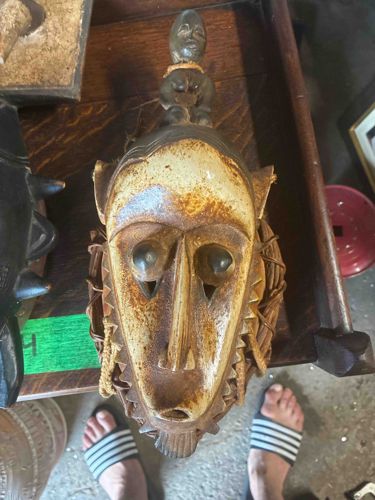
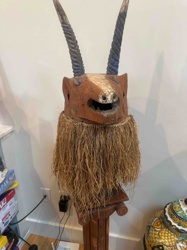
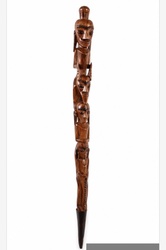
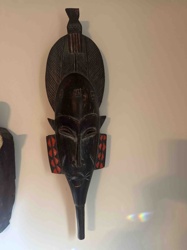
The item is a carved wooden mask, likely originating from an African tribal tradition. It exhibits a somewhat elongated, stylized face with prominent features. The primary material appears to be a light-colored wood, possibly stained or aged to achieve a reddish-brown and yellowish-white patina, particularly noticeable on the forehead and cheeks, suggesting significant age or intentional distressing. The eyes are deeply set, appearing as hollow, ovular openings, further accentuating the dramatic expression. A long, slender nose leads down to a small, circular mouth opening at the chin. The mask features ears that project slightly from the sides, and the overall construction includes sharp, jagged or serrated elements along the sides of the face, perhaps carved to represent hair, dreadlocks, or stylized ornamentation. These side elements are further adorned with tightly wrapped woven fibers or rope, adding textural contrast and suggesting a more complex construction or intended presentation. Atop the mask, there is a smaller, dark-colored carved figure, possibly a human or ancestral representation, seated in a crouching or kneeling position, acting as a finial. This finial figure also appears to be made of wood and exhibits a darker, possibly ebonized or heavily patinated finish, distinct from the main mask's color. The craftsmanship indicates hand-carving, evident in the slightly irregular surfaces and the organic flow of the contours. There are visible signs of wear and age, including discoloration, slight chipping on edges, and a general worn appearance consistent with a used or aged artifact. The woven material on the sides shows some fraying. The exact style period is difficult to ascertain without more context, but it aligns with traditional African tribal masks.
AI Appraisal Report
Upon examining the provided images of this African Tribal Mask with Finial Figure, my initial assessment suggests a compelling piece of cultural artifact. The mask exhibits characteristics consistent with traditional hand-carved tribal art, evident in the slightly uneven surfaces and organic contours of the wood. The reddish-brown and yellowish-white patina, particularly on the prominent facial features, points towards significant age or intentional aging techniques, enhancing its perceived antiquity. The deeply set, hollow eyes, long nose, and distinct circular mouth opening contribute to a striking, stylized expression.
From a condition standpoint, the mask appears to be in good, aged condition. The visible signs of wear, including discoloration, minor chipping on edges, and general surface wear, are consistent with an authentic, used artifact rather than significant damage. The tightly wrapped woven fibers on the side elements show some fraying, which is expected with age and handling of such materials. The darker, possibly ebonized, finial figure atop the mask provides an attractive contrast and indicates a thoughtful, intricate construction.
Authenticity, based on images alone, is always a primary consideration. While the craftsmanship and visible signs of age lend credibility, definitively ascertaining its origin, exact tribal affiliation, or precise age would require a physical examination. In-person inspection would allow for tactile evaluation of the wood grain, patina consistency, and carving marks, which can reveal tool usage and regional carving styles. Furthermore, scientific testing, such as radiocarbon dating, could provide a more precise age, and a thorough lineage of ownership (provenance documentation) would be crucial for establishing its historical context and confirming its journey from its place of origin.
Regarding market conditions, traditional African tribal masks have seen consistent demand, particularly for pieces exhibiting strong aesthetic qualities, good condition, and verifiable provenance. The rarity of such items is often tied to their age, the specific tribe of origin, and the skill of the carver. This particular piece, with its unique finial figure and expressive carving, possesses elements that would appeal to collectors of ethnographic art. Without definitive provenance or in-person verification, the market value is largely based on its visual appeal as an aesthetic object rather than a documented historical artifact. Should provenance be established, or physical examination confirm significant age and specific tribal origin, the value could increase considerably.
Given the visual evidence, which suggests an authentic and aesthetically pleasing antique or vintage tribal mask, but acknowledging the inherent limitations of evaluating authenticity solely from images, I would place its current market value within the range provided.