These notes were written by the person who submitted this item. Appraiser.AI has not verified them, and the AI's identification and estimate may rely on them.
AI Estimated Value
Not an official valuation
$250-400
AI estimate as of August 31, 2025 · verify with a professional before acting
AI-Generated · Verify before acting
Everything on this page is generated by AI for informational purposes only. AI can make mistakes — the AI may misidentify items or misattribute them (artist, maker, brand, designer, origin, era). This is not an official valuation and should not be used for insurance, sale, tax, estate, legal, or lending purposes — or any decision requiring a certified appraisal. It is not an authoritative claim about any person, brand, or rights holder — do not share or rely on it as a factual statement about a third party. Always consult qualified professionals before making financial decisions.
This analysis also relies on unverified notes provided by the user, which may be incomplete or inaccurate and could affect the result.
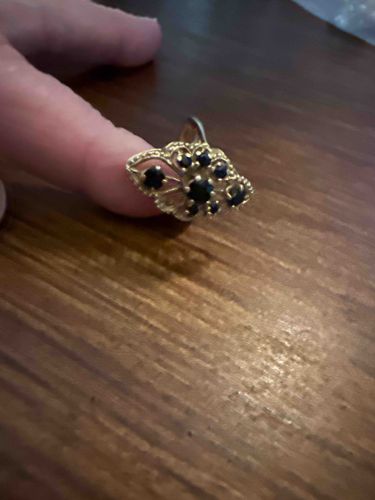
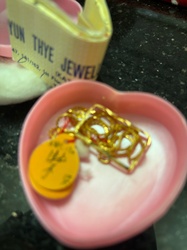
This is a yellow gold ring, likely 14k as per the provided context, featuring a decorative filigree design on the head, accented with numerous small, dark gemstones. The overall shape of the ring's head appears to be an elongated oval or stylized butterfly/floral motif, measuring approximately 1.5 cm in length and 1 cm in width. The gold exhibits a warm, mellow tone, characteristic of higher karatage gold, and shows some signs of gentle wear, consistent with regular use, such as minor surface scratches and possibly a slight patina in the recessed areas of the filigree, enhancing its antique aesthetic. The filigree work is intricate, showcasing delicate openwork patterns that contribute to a light and airy feel. Set within this filigree are multiple round-cut gemstones, which, based on the provided context are garnets. These stones are dark, appearing almost black in the image due to lighting, but would typically exhibit a deep red hue under brighter conditions. There are approximately 8-10 visible stones, varying slightly in size, set in what appears to be bezel or claw settings, though the image resolution makes precise identification difficult. The craftsmanship suggests a commercially produced piece, potentially from the mid-20th century, given the style. No visible damage such as cracks, missing stones, or significant deformation is apparent, though a thorough inspection would require higher resolution images. The ring appears to be in good, wearable condition. The band's thickness and design are not fully visible, but the overall impression is of a robust piece of costume or fine jewelry designed for everyday wear.
AI Appraisal Report
Based on my visual examination of the provided image, this 14k yellow gold garnet filigree ring appears to be in good, wearable condition. The intricate filigree work is well-preserved, showing typical signs of gentle wear consistent with its age, such as minor surface scratches and a slight patina in recessed areas. The numerous small, round-cut gemstones, identified as garnets, are all present, and their settings appear secure, though the image resolution limits precise identification of setting type (likely bezel or claw). The overall design, with its elongated oval/floral motif, suggests a mid-20th-century aesthetic.
Market conditions for vintage 14k gold jewelry, especially pieces with filigree and semi-precious stones like garnets, remain stable. While not 'rare,' well-maintained examples like this are consistently sought after. The value is primarily driven by the gold content, the craftsmanship of the filigree, and the condition of the gemstones. Factors impacting value include the 14k gold purity, the intricate openwork, and the full complement of stones. The current retail value for similar vintage 14k gold garnet rings typically falls within the $250-$400 range, depending on weight and exact design.
It is crucial to note the limitations of authenticating solely from images. While the '14k' identification is provided, I cannot, from the image alone, definitively verify the gold purity or the gemstone authenticity. For full authentication and a more precise appraisal, a physical examination would be necessary to test the gold for karatage, confirm the stones are indeed natural garnets (and not simulants), assess their quality (clarity, cut), and determine the exact weight of the piece. Provenance documentation, if available, would also add to its verifiable history.