AI Appraisal Estimate

AI-generated estimates · not official valuations

From the user

What was submitted

Photo and notes provided by the user — not generated by AI

Submitted item photo
Submitted photo · May 25, 2026

User's notes

No additional notes provided.

AI analysis below

AI appraisal

AI analysis & estimate

AI-Generated · Verify before acting

Everything below is generated by AI for informational purposes only. AI can make mistakes — the AI may misidentify items or misattribute them (artist, maker, brand, designer, origin, era). This is not an official valuation and should not be used for insurance, sale, tax, estate, legal, or lending purposes — or any decision requiring a certified appraisal. It is not an authoritative claim about any person, brand, or rights holder — do not share or rely on it as a factual statement about a third party. Always consult qualified professionals before making financial decisions.

Read the full disclaimer

AI Identification

·Not independently authenticated·Verify before acting

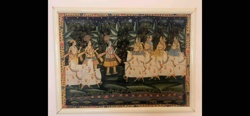
Radha-Krishna Maha Raas Leela Miniature Painting

Asian Fine Art / Indian Miniature Painting

AI Estimated Value

·Not an official valuation·Verify before acting

$200 - $400

As of May 25, 2026

AI Item Analysis

·AI can make mistakes·Verify before acting
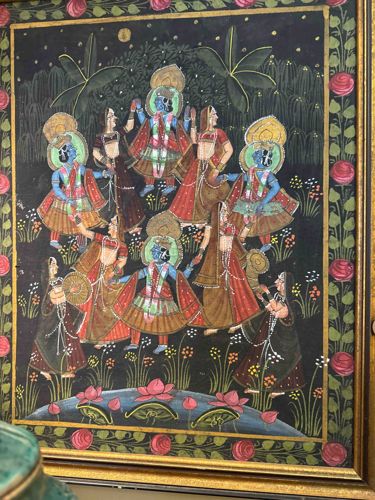
This is a detailed Indian miniature painting, likely in the Pichwai or Rajasthani style, depicting the 'Maha Raas Leela' where Lord Krishna multiplies himself to dance with Radha and the Gopis. The piece features several blue-skinned Krishna figures in dynamic dancing poses, adorned in vibrant orange and red dhotis with ornate gold-tone jewelry and halos. The female figures (Gopis) are dressed in traditional lehngas with translucent veils, rendered in a palette of deep reds, browns, and blacks. The background is a dense, dark forest scene under a night sky with a golden moon and stars, accented by stylized banana trees and a variety of colorful wildflowers. The foreground depicts a small lotus pond with pink blooms. The entire composition is enclosed within a decorative floral border featuring pink roses and green vines on a black ground, held within a simple gilded wood frame. The craftsmanship shows intricate linework, particularly in the drapery and facial features of the subjects. Condition appears fair to good for its age, with some visible surface wear, minor pigment loss, and slight cracking in the paint layer, which is consistent with early to mid-20th-century devotional folk art or tourist-export miniatures. No visible artist signature is apparent in the image.
AI Appraisal Report

·AI can make mistakes·Verify before acting
Upon examining this Indian miniature painting depicting the 'Maha Raas Leela,' I would date this piece to the mid-to-late 20th century. While it draws heavily on the aesthetics of Nathdwara Pichwai and traditional Rajasthani court paintings, the execution suggests it is a later devotional work or a high-quality production for the export market rather than an antique court piece. The vibrant, somewhat saturated pigments and the brushwork lacks the microscopic refinement seen in 18th or 19th-century originals. The condition is fair; I observed noticeable surface wear, scattered pigment loss, and visible crazing (cracking) in the paint layer, which impacts its desirability for serious collectors but adds a certain vintage charm. The market for 20th-century Indian folk and traditional art is flooded with reproductions, making provenance crucial. Without a signature or documented history, this piece is evaluated primarily on its decorative merit and skilled composition. The 'Raas Leela' is a beloved and iconic subject, ensuring consistent demand among casual collectors and devotees. Comparable mid-century works of this size and quality typically sell at auction or in galleries for between $200 and $400. Limitations of this assessment include the inability to physically inspect the substrate (paper, cloth, or ivory) and the pigments. Absolute authentication would require microscopic analysis of the paint chemistry to rule out modern synthetic binders and close inspection of the paper grain. However, based on visual evidence, it stands as a charming, decorative example of traditional Indian devotional art.

Get your items appraised

Instant estimates of your treasures with AI-powered appraisals

Browse More Appraisals