AI estimate as of December 8, 2025 · verify with a professional before acting
AI-Generated · Verify before acting
Everything on this page is generated by AI for informational purposes only. AI can make mistakes — the AI may misidentify items or misattribute them (artist, maker, brand, designer, origin, era). This is not an official valuation and should not be used for insurance, sale, tax, estate, legal, or lending purposes — or any decision requiring a certified appraisal. It is not an authoritative claim about any person, brand, or rights holder — do not share or rely on it as a factual statement about a third party. Always consult qualified professionals before making financial decisions.
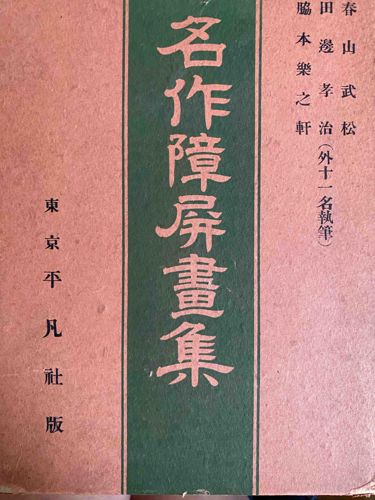
This item is a historical Japanese book titled "名作障屏畫集" (Meisaku Shōhei Gashū), which translates to "Collection of Masterpiece Screen Paintings." The cover features a two-tone design, with the majority of the cover in a muted, reddish-pink (possibly faded peach or light terracotta) color, and a prominent vertical green strip running down the center. The title is inscribed in white or very light-colored Japanese characters on this central green strip, rendered in an elegant, stylized calligraphic font. To the right of the title, several names are listed vertically in smaller Japanese characters, indicating contributors or artists featured in the collection: "春山武松" (Haruyama Takematsu), "田邊孝治" (Tanabe Kōji), and "脇本樂之軒" (Wakimoto Rakushiken), followed by "(外十一名執筆)" which means "(eleven others contributed/authored)". To the left of the title strip, in the reddish-pink section, the publisher and location are printed vertically: "東京" (Tokyo) and "平凡社版" (Heibonsha Publishing). The physical condition shows signs of age and handling; the reddish-pink paper exhibits visible foxing, discoloration, and some scuffing, particularly towards the edges and corners, indicating wear consistent with an older publication. The green strip appears more preserved in color but also shows some minor surface wear. The overall aesthetic suggests an early to mid-20th-century publication, likely a scholarly or art historical compilation of traditional Japanese screen paintings. The quality of the printing and paper seems robust for its age, typical of a well-produced art book. No major tears or significant structural damage are immediately visible, but the surface wear is noticeable and expected for an item of this presumed age and material.
AI Appraisal Report
Based on my visual examination of the provided image of "名作障屏畫集" (Meisaku Shōhei Gashū), I assess this historical Japanese art book to be an appealing, though moderately aged, publication. The authenticity, from a visual standpoint, appears assured given the clear title, publisher details (Heibonsha Publishing, Tokyo), and listed contributors (Haruyama Takematsu, Tanabe Kōji, Wakimoto Rakushiken, and 'eleven others'). These names align with known figures in Japanese art history and publishing during the early to mid-20th century, which is consistent with the aesthetic cues of the book. Without further visual context of the interior, this appraisal assumes it is a complete volume. The condition shows clear signs of age-appropriate wear, including foxing, discoloration, and scuffing on the reddish-pink cover, particularly at the edges. While the green strip is better preserved, minor surface wear is still noticeable. No major structural damage is immediately apparent, which is a positive factor for an item of its presumed age.
In terms of market conditions, historical Japanese art books, especially compilations of screen paintings, generally hold niche interest among collectors, scholars, and institutions. Comparables would include similar illustrated art books from the Taishō or early Shōwa periods. The Heibonsha name implies a reputable publisher, which adds to its desirability. Demand, while not exceptionally high for single volumes unless they feature rare artists or exceptional printing quality, is steady within specialized circles. Its rarity is moderate; while not a unique manuscript, specific editions from this era can become less common over time. Factors impacting value significantly include the interior content (quality of reproductions, specific artists featured), binding integrity, and whether it's part of a multi-volume set (which could alter its value if incomplete).
My primary limitation in full authentication and valuation is the lack of physical examination. I cannot assess paper quality, binding integrity firsthand, or examine the interior pages for completeness, print quality, or potential hidden damage (e.g., loose pages, water damage, or mold). To fully authenticate and confirm value, an in-person examination would be critical to verify paper stock, ink quality, and the state of the binding. Provenance documentation, if available, could also significantly enhance its value by detailing its ownership history or any notable acquisitions. Scientific testing, while possible (e.g., for paper composition or ink dating), is generally not pursued for books of this type unless there are serious doubts about its age or authenticity not evident from visual inspection.