These notes were written by the person who submitted this item. Appraiser.AI has not verified them, and the AI's identification and estimate may rely on them.
AI Estimated Value
Not an official valuation
$250-400
AI estimate as of December 15, 2025 · verify with a professional before acting
AI-Generated · Verify before acting
Everything on this page is generated by AI for informational purposes only. AI can make mistakes — the AI may misidentify items or misattribute them (artist, maker, brand, designer, origin, era). This is not an official valuation and should not be used for insurance, sale, tax, estate, legal, or lending purposes — or any decision requiring a certified appraisal. It is not an authoritative claim about any person, brand, or rights holder — do not share or rely on it as a factual statement about a third party. Always consult qualified professionals before making financial decisions.
This analysis also relies on unverified notes provided by the user, which may be incomplete or inaccurate and could affect the result.
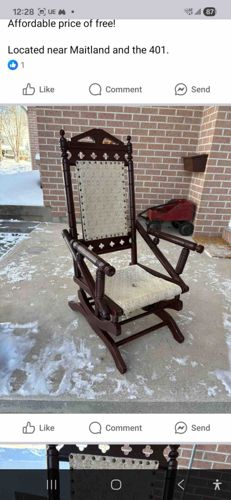
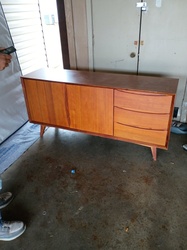
This is a Victorian-style rocking chair, likely constructed from a dark-stained hardwood, possibly oak or mahogany, given its deep reddish-brown hue. The chair features a high back with an elaborate carved crest at the top, exhibiting scrollwork and possibly a central motif, though specific details are somewhat obscured. Below the crest, the backrest is upholstered with a light-colored, possibly cream or beige, fabric, which appears to have a subtle pattern, possibly floral or damask, repeated throughout. The upholstery is bordered by a series of small, decorative tacks or studs, adding to its vintage appeal. The frame of the backrest also includes smaller, decorative cut-outs or fretting along its top edge, immediately beneath the crest. The armrests are solid and rounded, supported by turned spindles or carved elements, and the seat is also upholstered with the same light-colored fabric, showing some indentation from use. The rockers are smoothly curved, providing the chair's characteristic motion. The overall construction appears sturdy, with visible mortise and tenon or dowel joints. The finish shows some minor wear, consistent with age and use, particularly on the edges and high-contact areas, but no major chips or gouges are apparent. No obvious maker's marks or signatures are discernible from the image. The style points to a late 19th or possibly early 20th-century piece, designed to evoke the grandeur of the Victorian era. The craftsmanship, with its detailed carving and upholstery work, suggests a reasonably well-made piece of furniture for its time, though not necessarily high-end artisan work.
AI Appraisal Report
Based on my visual examination of the provided image, this Victorian-style rocking chair appears to be a late 19th or early 20th-century piece, likely constructed from a dark-stained hardwood such as oak or mahogany. The condition is good, exhibiting wear consistent with age and use, including minor finish abrasions but no significant structural damage or major chips. The upholstery, while appearing well-maintained for its age, shows some indentation from use and would likely benefit from professional cleaning or eventual replacement to enhance its aesthetic appeal. The decorative carving and turned elements indicate a level of craftsmanship above mass-produced, though not necessarily artisan-level.
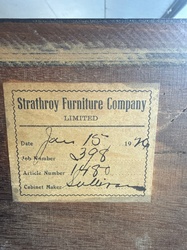
Authenticity verification from images alone is inherently limited. While the style strongly suggests a Victorian-era origin, a physical inspection would be crucial to confirm wood species, joinery methods, and the age of the original finish and upholstery. I would look for specific maker's marks or labels, examine the fasteners and internal construction, and potentially take wood samples for dendrochronology or fiber analysis of the upholstery for definitive dating.
The market for Victorian-style rocking chairs is generally steady but not experiencing a significant boom. While decorative and functional, they are not exceedingly rare. Comparables in similar condition typically fall within the $200-$500 range, with higher values for pieces with original, pristine upholstery or exceptional provenance. Demand is moderate, appealing to those seeking antique or vintage furniture for décor or practical use. The lack of discernible maker's marks and the somewhat generic 'Victorian-style' classification temper a higher valuation. The relatively good condition and elaborate carving contribute positively to its value within this range.