These notes were written by the person who submitted this item. Appraiser.AI has not verified them, and the AI's identification and estimate may rely on them.
AI Estimated Value
Not an official valuation
$40-60
AI estimate as of August 7, 2025 · verify with a professional before acting
AI-Generated · Verify before acting
Everything on this page is generated by AI for informational purposes only. AI can make mistakes — the AI may misidentify items or misattribute them (artist, maker, brand, designer, origin, era). This is not an official valuation and should not be used for insurance, sale, tax, estate, legal, or lending purposes — or any decision requiring a certified appraisal. It is not an authoritative claim about any person, brand, or rights holder — do not share or rely on it as a factual statement about a third party. Always consult qualified professionals before making financial decisions.
This analysis also relies on unverified notes provided by the user, which may be incomplete or inaccurate and could affect the result.
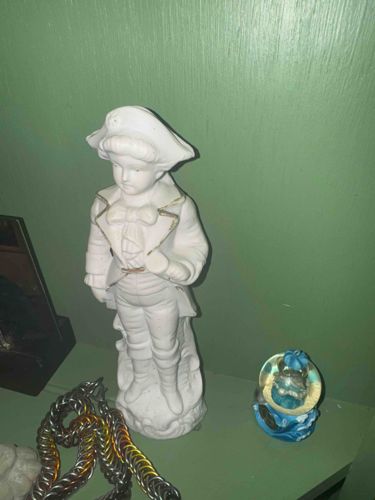
This item is a decorative bisque porcelain or plaster figurine depicting a young boy, likely a fictional character or a generic representation of a historical figure, possibly a 'Colonial Boy' or 'Page Boy' type. The figure stands approximately 10-12 inches tall, judging by its proportion to the visible shelf. It is entirely white, suggesting it might be unglazed bisque or painted plaster. The boy is depicted wearing a tricorne hat, a ruffled shirt or cravat, a formal jacket with lapels, and breeches with boots. His right arm is bent, and his hand appears to be holding a small, indistinct object. The jacket features faint gold outlines along the lapels and cuffs, indicating some form of hand-painting or application of gold gilt, which shows signs of wear, flaking, or rubbing off in several areas. The construction suggests it was cast from a mold, with some detail in the facial features and clothing folds. The surface appears matte rather than glossy, typical of bisque. There are no visible chips or cracks from the provided images, but the overall white surface shows some subtle discoloration or dirt accumulation, consistent with age and display. The base is an integral part of the molding, depicting some rock-like or naturalistic texture, providing stability for the tall, slender figure. The overall style suggests a period from the early to mid-20th century, possibly as a mass-produced decorative item rather than a fine art sculpture. Its craftsmanship is good, with clear details and a relatively smooth finish, though the hand-applied gold accents are somewhat simple.
AI Appraisal Report
I have examined the provided images and the detailed description of this decorative bisque porcelain or plaster figurine. Based on my visual assessment, the item depicts a young boy in period attire, likely a 'Colonial Boy' or 'Page Boy' type, standing approximately 10-12 inches tall. The material appears to be unglazed bisque porcelain or painted plaster due to its matte white finish, consistent with the described characteristics. While the owner refers to it as a 'Soldier statue,' the attire suggests more of a civilian or page boy rather than a military figure. The gold accents, although showing wear, add a touch of period appropriate detail.
Condition-wise, the figurine appears generally good from the images provided; no major chips or cracks are evident, which is positive for older decorative items. The slight discoloration or dirt build-up is typical of age and display and would likely improve with a careful cleaning.
In terms of market conditions, items like this, produced in the early to mid-20th century as mass-produced decorative pieces, generally fall into the affordable collectibles category. While individual artist pieces or antique items from specific manufacturers (e.g., German porcelain makers) command higher prices, generic decorative figurines typically have a more modest value. Demand is present but not exceptionally high for such items, and they are not considered rare. Factors impacting value include the lack of a known manufacturer's mark, which would significantly increase its desirability and price if from a reputable pottery, and the general wear to the gold detailing.
Without a physical examination, I cannot definitively confirm the material (bisque vs. plaster) or the presence of any maker's marks, which are crucial for full authentication and precise dating. A direct inspection would also allow for a more thorough assessment of any subtle damage, repairs, or the exact composition of the material. Provenance documentation, if available, would also add value and authenticity. Scientific testing, such as examining the material composition, is not typically warranted for items in this price range but could confirm bisque if necessary.
Considering all these factors, I have concluded the following appraisal value.