AI estimate as of July 10, 2025 · verify with a professional before acting
AI-Generated · Verify before acting
Everything on this page is generated by AI for informational purposes only. AI can make mistakes — the AI may misidentify items or misattribute them (artist, maker, brand, designer, origin, era). This is not an official valuation and should not be used for insurance, sale, tax, estate, legal, or lending purposes — or any decision requiring a certified appraisal. It is not an authoritative claim about any person, brand, or rights holder — do not share or rely on it as a factual statement about a third party. Always consult qualified professionals before making financial decisions.
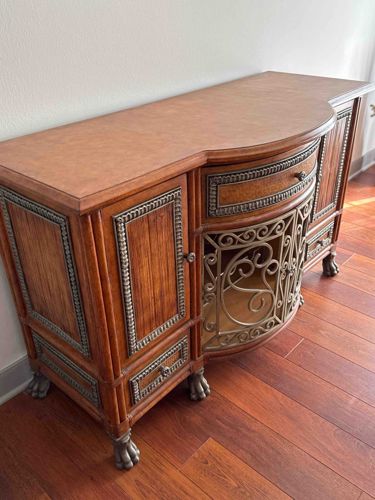
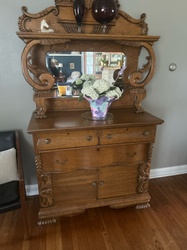
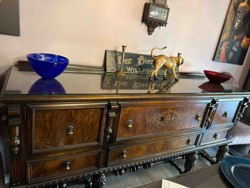
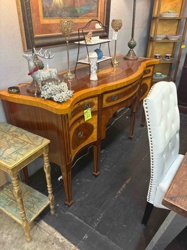
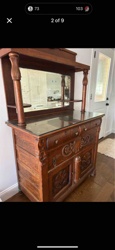
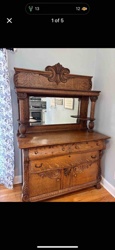
This is an elaborate wooden sideboard or buffet cabinet, characterized by its rich, reddish-brown wood finish and intricate metalwork accents. The piece features a long, rectangular top surface, with a notable curved central section that protrudes outward, adding an architectural dimension. The top appears to be a solid surface, possibly wood or a wood-look laminate, with a slightly lighter, warmer tone than the body of the cabinet. The front facade is highly decorative, comprising two vertical cabinet doors on either side of the central curved section. These doors are framed with decorative trim featuring a repetitive, possibly beaded or rope-like pattern, finished in a dark, aged metallic tone, likely bronze or dark pewter. Within these frames, the wood panels exhibit a vertical plank or reeded texture. Below each side cabinet door, there is a small drawer, similarly framed with the same distinctive metallic trim and equipped with a small, circular pull handle. The most striking feature is the central curved section, which includes a drawer at the top, matching the side drawers, and below it, an open compartment enclosed by an ornate, scrolled metal grille. This grille is finished in a lighter, antique gold or brass tone and features an intricate, organic, swirling design reminiscent of Art Nouveau or Neoclassical motifs, providing visibility into the shelving or contents behind it. The entire piece is supported by four detailed claw-foot legs, one beneath each corner, crafted from a dark, metallic material that matches the trim. These legs contribute to a robust and classic aesthetic. The visible condition appears good, with minor signs of wear consistent with use, such as light scratches or scuffs, but no significant damage or repairs are immediately apparent. The craftsmanship suggests a manufactured piece, possibly from the late 20th century or early 21st century, designed to emulate traditional or antique styles with a focus on rich materials and decorative embellishments.
AI Appraisal Report
Upon examining the image of this ornate wooden sideboard, I observe a piece likely manufactured in the late 20th or early 21st century, designed to evoke traditional or antique styles. The condition appears to be good, displaying minor wear consistent with use, such as light surface scuffs, but no significant damage or repairs are evident. The rich reddish-brown wood finish, intricate metallic accents (dark bronze/pewter trim, antique gold/brass grille), and detailed claw feet contribute to its aesthetic appeal. Authenticity as an antique is highly unlikely; it presents as a commercially produced decorative furniture item. The craftsmanship, while detailed, points to mass production rather than artisan handcraftsmanship.
Market conditions for this type of decorative, reproduction-style furniture are moderate. While the aesthetic has broad appeal, the market is saturated with similar pieces, limiting rarity. Demand is present, particularly for those seeking substantial, ornate pieces to serve as focal points in dining or living areas. Factors impacting value include its good condition, visually appealing design, and functional storage capacity.
Limitations on authenticity verification from images alone are significant. I cannot definitively assess the wood species, internal construction methods, or actual age without physical inspection. An in-person examination would allow me to check joinery, drawer construction, reverse sides of metalwork, and assess the true quality of materials. Provenance documentation, though unlikely for a manufactured piece of this nature, would confirm its origin and manufacturing date. Scientific testing, such as dendrochronology for wood dating, is not applicable or necessary for an item likely of this recent production period and style.