These notes were written by the person who submitted this item. Appraiser.AI has not verified them, and the AI's identification and estimate may rely on them.
AI Estimated Value
Not an official valuation
$60-90
AI estimate as of September 14, 2025 · verify with a professional before acting
AI-Generated · Verify before acting
Everything on this page is generated by AI for informational purposes only. AI can make mistakes — the AI may misidentify items or misattribute them (artist, maker, brand, designer, origin, era). This is not an official valuation and should not be used for insurance, sale, tax, estate, legal, or lending purposes — or any decision requiring a certified appraisal. It is not an authoritative claim about any person, brand, or rights holder — do not share or rely on it as a factual statement about a third party. Always consult qualified professionals before making financial decisions.
This analysis also relies on unverified notes provided by the user, which may be incomplete or inaccurate and could affect the result.
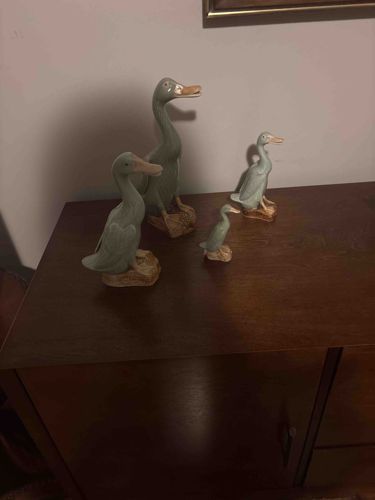
This is a charming set of four ceramic duck figurines, likely designed for decorative purposes. The ducks vary in size, depicting a family group ranging from large adults to smaller ducklings. Each figurine is rendered in a soft, muted grey-green color, with subtle variations suggesting natural feathering. The beaks of the ducks are painted in a contrasting light orange-brown hue, and their eyes are delineated with small black dots. Each duck is depicted standing on a textured, rock-like base, painted in earth tones of brown and beige, which provides stability and adds to the naturalistic aesthetic. The craftsmanship appears to be of good quality, with smooth glazing and carefully applied details. The poses are naturalistic, with heads often slightly turned, giving them an engaging and lifelike appearance. There are no visible chips, cracks, repairs, or significant wear on any of the figurines, indicating they are in excellent condition. The style suggests a decorative item from the mid-to-late 20th century, possibly ceramic or porcelain. The consistent coloring and base design across all four pieces suggest they were produced as a matching set. The varied sizes and naturalistic depiction make them suitable for display in a country-style or nature-themed interior.
AI Appraisal Report
Upon my virtual examination of the Set of Four Ceramic Duck Figurines, I assess their condition as excellent, consistent with the owner's description. The smooth glazing, carefully applied details, and lack of visible chips, cracks, repairs, or significant wear are indicative of well-preserved decorative items. The consistent aesthetic across all four pieces confirms they are a matching set, enhancing their collective appeal.
From a market perspective, these figurines fall into the category of decorative ceramics, often associated with a country or nature-themed interior design. While charming, such items are generally not considered rare. The estimated mid-to-late 20th-century origin places them within a period of prolific decorative ceramic production. Demand for these types of decorative figurines is steady but not particularly high, with value typically driven by aesthetic appeal and flawless condition rather than rarity or significant artistic provenance.
Comparable items, often found in online marketplaces, antique shops, or estate sales, typically range from $15 to $30 per individual figurine in good condition, or slightly more for a complete set. The present excellent condition and the cohesive nature of this set elevate its value beyond that of individual, potentially mismatched pieces. Factors significantly impacting value include the excellent condition, the complete set aspect, and their appealing, naturalistic design.
It is important to note the limitations of an appraisal based solely on images. While the visual details suggest ceramic or possibly porcelain, a physical inspection would be required to definitively confirm the material, manufacturing techniques, and to search for any maker's marks or stamps that might indicate a specific manufacturer or artist, which could potentially impact authenticity and value. Without provenance documentation, full authentication of origin or specific artist attribution remains speculative. However, for decorative pieces of this nature, such in-person verification is typically not a primary factor affecting their market value, which is largely driven by condition and visual appeal.