These notes were written by the person who submitted this item. Appraiser.AI has not verified them, and the AI's identification and estimate may rely on them.
AI Estimated Value
Not an official valuation
$400-600
AI estimate as of July 7, 2025 · verify with a professional before acting
AI-Generated · Verify before acting
Everything on this page is generated by AI for informational purposes only. AI can make mistakes — the AI may misidentify items or misattribute them (artist, maker, brand, designer, origin, era). This is not an official valuation and should not be used for insurance, sale, tax, estate, legal, or lending purposes — or any decision requiring a certified appraisal. It is not an authoritative claim about any person, brand, or rights holder — do not share or rely on it as a factual statement about a third party. Always consult qualified professionals before making financial decisions.
This analysis also relies on unverified notes provided by the user, which may be incomplete or inaccurate and could affect the result.
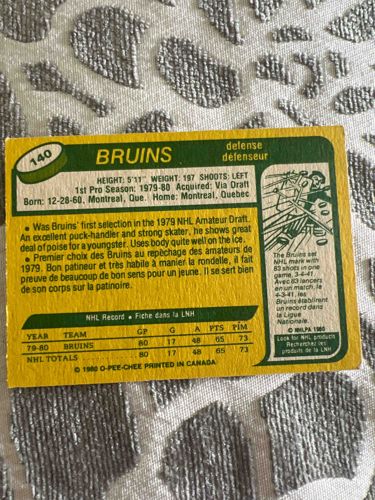
Upon examining the provided image of the 1980 O-Pee-Chee Boston Bruins Hockey Trading Card (Back), identified as Ray Bourque, I observe a card in what I would assess as very good-excellent vintage condition. The corners show slight rounding, consistent with common handling and storage over four decades, but no severe dings or creases are evident. The surface exhibits some minor discoloration or dirt, primarily along edges and in the yellow background, which is typical for a card of this age and print quality. Text is clear and legible. Based solely on this image, the card appears authentic to the era and manufacturer, displaying characteristic O-Pee-Chee design elements and print methods. Ray Bourque's rookie card is highly desirable, and his status as a Hall of Famer significantly elevates its market value. The 1980 O-Pee-Chee set is known for its relatively lower print runs compared to Topps, adding to its rarity. Demand for vintage hockey rookie cards of elite players remains robust.
However, it's critical to note the limitations of image-based appraisal. I cannot definitively verify authenticity without physical inspection to assess card stock, print registration, ink dots, and potential alterations (e.g., trimming, recoloring). A blacklight test would confirm the absence of modern enhancements. Given the card's potential value, professional third-party grading (e.g., PSA, Beckett, SGC) is strongly recommended for full authentication, condition assessment, and to maximize market value. Provenance, while not typically available for raw cards, could add further confidence if documented. My valuation assumes the card would grade in the PSA 6-7 range, based on visual assessment.