These notes were written by the person who submitted this item. Appraiser.AI has not verified them, and the AI's identification and estimate may rely on them.
AI Estimated Value
Not an official valuation
$10-20
AI estimate as of November 14, 2025 · verify with a professional before acting
AI-Generated · Verify before acting
Everything on this page is generated by AI for informational purposes only. AI can make mistakes — the AI may misidentify items or misattribute them (artist, maker, brand, designer, origin, era). This is not an official valuation and should not be used for insurance, sale, tax, estate, legal, or lending purposes — or any decision requiring a certified appraisal. It is not an authoritative claim about any person, brand, or rights holder — do not share or rely on it as a factual statement about a third party. Always consult qualified professionals before making financial decisions.
This analysis also relies on unverified notes provided by the user, which may be incomplete or inaccurate and could affect the result.
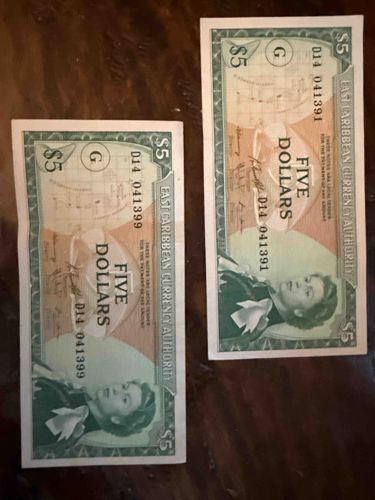
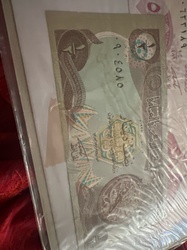
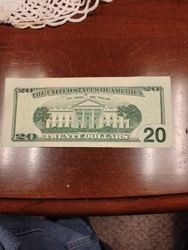
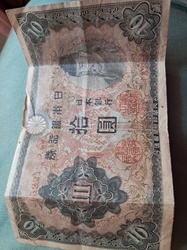
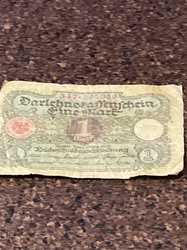
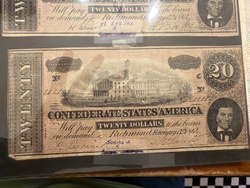
The image displays two East Caribbean Five Dollars banknotes. Both are rectangular in shape, made of paper, and share a consistent design. The primary colors appear to be green, orange-pink, and cream. The denomination '$5' is prominently featured in all four corners of each note, as well as centrally on the upper left and upper right. The words 'FIVE DOLLARS' are printed vertically in the center of the notes. Each note also bears the inscription 'EAST CARIBBEAN CURRENCY AUTHORITY' vertically along the right side. A portrait, likely of Queen Elizabeth II, is situated in the lower left quadrant of each note. The serial numbers 'D14 041391' and 'D14 041399' are visible on the notes, indicating they are from the same series but distinct. 'G' is also printed near the top left of the central design on both notes. The notes appear to be in circulated condition, with some minor creasing visible, particularly on the note on the left. The printing quality seems consistent with official currency production, exhibiting fine line work and security features inherent in banknotes. The overall aesthetic suggests a mid to late 20th-century design. No significant tears or major damage are immediately evident, but a more detailed inspection would be needed to ascertain their precise condition and grade.
AI Appraisal Report
I have examined the image provided of two East Caribbean Five Dollars banknotes, serial numbers D14 041391 and D14 041399. Visually, these appear to be authentic East Caribbean Currency Authority notes, consistent with issues featuring Queen Elizabeth II's portrait. The design elements, including denomination, text, and security features like the portrait, align with known authentic examples of this currency type. However, authenticity cannot be definitively confirmed from images alone; I would require an in-person examination to verify security threads, watermarks, and other tactile features.
The condition of both notes appears to be circulated, with visible creasing, particularly on the left note. This suggests a Fine to Very Fine grade according to standard currency grading scales. There are no obvious tears or significant damage visible, which is positive.
From a market perspective, these circulated five-dollar notes are not considered rare. While they hold historical and illustrative value, their monetary value typically exceeds face value only marginally, often dependent on condition and specific series features. Comparing to recent sales of similar circulated East Caribbean banknotes, the demand for common circulating issues is moderate among collectors. Higher-grade examples or uncirculated notes fetch significantly more, but these fall into the widely available category. Factors impacting value are primarily condition and authenticity. Without physical inspection for security features and paper quality, and knowing the exact year of issue, a precise valuation is challenging.
For full authentication and a more precise grade, I would need to physically inspect the notes, examine them under magnification for printing anomalies, check the security thread and watermark, and assess the paper's crispness and any unseen damage. Provenance documentation, though less critical for common circulated notes, would also add to their verifiable history.