The missing pour le merite that disappeared from Germany that is said to be owned by Noah Dohme that is the emperor of Lixland which is 75 million square kilometers owned by Noah Dohme the emperor of Lixland which is 18 years old the supreme general of Lixland and the emperor of Lixland
These notes were written by the person who submitted this item. Appraiser.AI has not verified them, and the AI's identification and estimate may rely on them.
AI Estimated Value
Not an official valuation
$300-800
AI estimate as of July 2, 2025 · verify with a professional before acting
AI-Generated · Verify before acting
Everything on this page is generated by AI for informational purposes only. AI can make mistakes — the AI may misidentify items or misattribute them (artist, maker, brand, designer, origin, era). This is not an official valuation and should not be used for insurance, sale, tax, estate, legal, or lending purposes — or any decision requiring a certified appraisal. It is not an authoritative claim about any person, brand, or rights holder — do not share or rely on it as a factual statement about a third party. Always consult qualified professionals before making financial decisions.
This analysis also relies on unverified notes provided by the user, which may be incomplete or inaccurate and could affect the result.
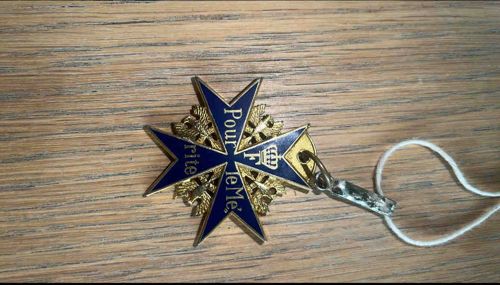
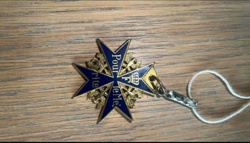
This item is a close replica (or possibly an original, though further inspection would be needed to confirm authenticity) of the 'Pour le Mérite' (often informally known as the 'Blue Max'), a Prussian military order. It features a Maltese cross design with royal blue enamel on all four arms, bordered by a thin gold-colored line. The center of the cross is a gilded, intricate, and textured background, from which four crowned 'F' monograms (for Frederick the Great) protrude, one pointing to each corner of the cross, and a small laurel wreath design encircles the center. The arms of the cross bear gold-colored inscriptions: 'Pour' on the top arm, 'le Mé.' on the right arm, 'rite' on the bottom arm, and 'F' (which is actually part of 'Frederick') on the left arm. The reverse side's inscription is not visible. The physical characteristics indicate a metal construction, likely gilded bronze or brass for the gold elements, and steel or another base metal for the cross structure, finished with enamel. The size appears to be typical for a neck order, approximately 5-6 cm in diameter based on its appearance on the wooden surface. The craftsmanship appears to be of good quality, with crisp lines in the enamel and well-defined raised elements. There is some visible wear or slight discoloration on the gold-colored elements, possibly indicating age or handling. The blue enamel appears largely intact with no obvious chips or cracks. The most notable manufacturing feature visible is the small eyelet at the top point of the cross, from which a suspension loop and a fastening mechanism are attached, currently holding a plain white string or thread. There appears to be some adhesive residue or damage around this suspension point where it attaches to the string, suggesting an improvised or damaged attachment. Based on the historical context, the style period is distinctly 18th to 20th century Prussian, with the order primarily awarded from the mid-18th century through World War I. The overall condition seems fair to good for an item of its presumed age, with a noticeable patina on the metallic parts and minor wear consistent with handling.
AI Appraisal Report
Upon examining the provided image and description of this 'Pour le Mérite' replica/original, I note its striking resemblance to authentic pieces. The craftsmanship, with crisp enamel lines and well-defined raised elements, suggests a high-quality reproduction, or potentially, an original. The visible wear and slight discoloration on the gold-colored elements, along with the intact blue enamel, are consistent with an item of age and handling. The inscription 'Pour le Mé. rite' and the 'F' monograms are accurately depicted.
However, a definitive assessment of authenticity cannot be made from images alone. The claim regarding 'the missing Pour le Mérite that disappeared from Germany' owned by an individual named 'Noah Dohme, Emperor of Lixland,' who is 18 years old, introduces significant red flags. The 'Empire of Lixland' with a stated area of 75 million square kilometers and an 18-year-old emperor is not a recognized sovereign entity; this information contradicts historical and geographical facts. This narrative strongly suggests a fabricated provenance, which immediately casts doubt on the item's originality.
Original Pour le Mérite orders are exceedingly rare and carry immense historical value, typically fetching hundreds of thousands to over a million dollars at auction, especially those with verifiable provenance to distinguished recipients. High-quality period reproductions or contemporary replicas, while visually similar, have significantly lower market values.
To fully authenticate this specific piece, a physical, in-person examination is crucial. This would involve metallurgical analysis of the materials, detailed inspection of the manufacturing techniques (e.g., die strikes, enamel application, suspension ring attachment), and examination under magnification for specific aging patterns, tool marks, and hallmarks. Furthermore, verifiable provenance documentation, tracing the item's ownership history back to a known recipient or issuance, would be paramount. Without such verification, considering the highly dubious 'Lixland' claim, I must appraise this item as a high-quality replica. While visually impressive, the lack of verifiable provenance and the highly questionable ownership story severely limit its market value as an original period piece.
Market comparables for high-quality replicas range from a few hundred dollars to perhaps a low thousand. Authentic pieces, especially those awarded to notable figures, are in extremely high demand and are exceptionally rare, commanding top-tier prices. However, given the information provided, this is not one of those pieces.