AI estimate as of September 6, 2025 · verify with a professional before acting
AI-Generated · Verify before acting
Everything on this page is generated by AI for informational purposes only. AI can make mistakes — the AI may misidentify items or misattribute them (artist, maker, brand, designer, origin, era). This is not an official valuation and should not be used for insurance, sale, tax, estate, legal, or lending purposes — or any decision requiring a certified appraisal. It is not an authoritative claim about any person, brand, or rights holder — do not share or rely on it as a factual statement about a third party. Always consult qualified professionals before making financial decisions.
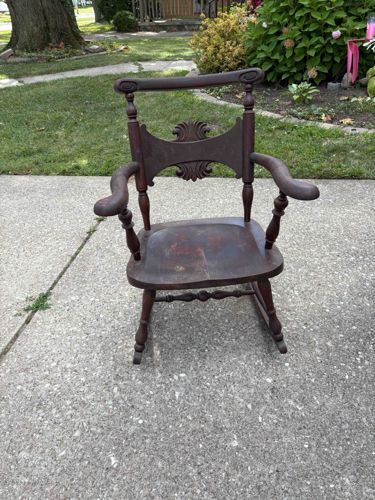
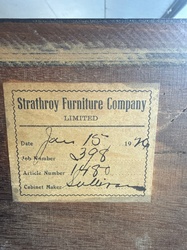
This appears to be an antique armchair, likely constructed from a dark-stained wood, possibly mahogany or a similar dark, dense timber, given its reddish-brown hue. The chair features a distinctive design, with a turned top rail connecting two elegantly turned stiles that descend to form the front legs. The armrests are gracefully curved, extending forward from the stiles and providing comfortable support. The most notable feature is the carved back splat, which showcases a central, ornate medallion-like motif flanked by a 'bow-tie' shaped support, indicating late 19th to early 20th-century aesthetic movement influences. The seat is a solid, contoured plank, showing significant wear, particularly in the center where the finish has rubbed away to reveal the lighter wood beneath, suggesting extensive use. The overall finish is a deep, rich brown with reddish undertones, and there are visible signs of aging including surface abrasions, minor chips, and a consistent patina across the wooden surfaces. The chair's legs are turned, with the front legs appearing to be slightly different in turning pattern than the rear. A simple stretcher connects the front and back legs. While no specific maker's marks are visible in the provided image, the craftsmanship, particularly the detailed carving and turning, suggests a well-made piece from its era. The robust construction points to a durable piece of furniture.
AI Appraisal Report
Based on my visual examination of the provided image, this antique dark-stained armchair appears to be a robust piece, likely dating from the late 19th to early 20th century. Its construction and styling, particularly the turned elements and the carved back splat with its medallion and 'bow-tie' motifs, are consistent with furniture from that period, suggesting authenticity. The dark stain and visible wood grain indicate a probable hardwood, possibly mahogany or a similar timber. Condition is fair; while it exhibits a desirable aged patina, there's significant wear to the seat's finish, several surface abrasions, and minor chips, all indicative of extensive use over time. These are consistent with its age and do not overly detract from its character, though the seat wear reduces its top-tier condition status.
In terms of market conditions, general demand for un-restored, period-specific armchairs like this has softened slightly compared to decades past, though well-made examples retain value. Comparables from this era with similar carving and turned features typically sell in the $200-$500 range, depending on condition and specific design. The unique back splat is a positive factor, adding visual interest. While not exceedingly rare, its craftsmanship sets it apart from mass-produced items.
A significant factor impacting value is the condition of the finish and the lack of a cushion, suggesting a plank seat which can be less comfortable for modern users. The absence of specific maker's marks is common for this period but means value hinges more on aesthetic appeal and condition rather than provenance.
It is crucial to note that this authenticity assessment is limited to visual examination of the image. A full authentication would require in-person inspection to assess wood species, joinery, and confirm the age of the materials and construction techniques. Provenance documentation would ideally confirm its history, and scientific testing could definitively date the wood or finish. Without physical inspection, factors like structural integrity (e.g., loose joints, woodworm) cannot be confirmed, which could impact value.