AI estimate as of November 25, 2025 · verify with a professional before acting
AI-Generated · Verify before acting
Everything on this page is generated by AI for informational purposes only. AI can make mistakes — the AI may misidentify items or misattribute them (artist, maker, brand, designer, origin, era). This is not an official valuation and should not be used for insurance, sale, tax, estate, legal, or lending purposes — or any decision requiring a certified appraisal. It is not an authoritative claim about any person, brand, or rights holder — do not share or rely on it as a factual statement about a third party. Always consult qualified professionals before making financial decisions.
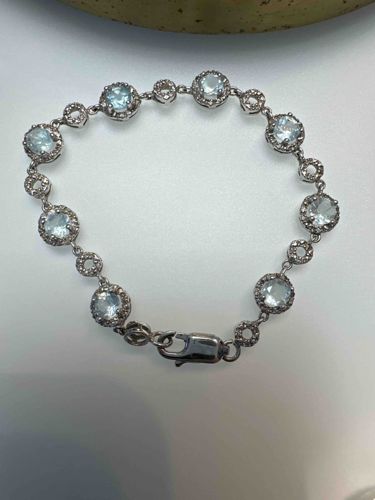
This exquisite bracelet is a classic tennis style, featuring a series of circular links alternated with bezel-set gemstones, primarily aquamarines, surrounded by a halo of smaller, pave-set diamonds. The metal appears to be a white metal, likely sterling silver or white gold, given its bright, reflective silver tone. There are eleven larger, round, faceted gemstones, which exhibit a light blue, transparent color, consistent with aquamarine. Each of these aquamarines is encircled by a halo of tiny, sparkling white stones, most likely diamonds, enhancing their brilliance. Between each larger gemstone link, there is a smaller, circular link also adorned with pave-set white stones, adding continuity and sparkle to the design. The construction consists of individual links connected by small jump rings, providing flexibility. The clasp is a lobster claw style, a common and secure mechanism for bracelets, also appearing to be made of the same white metal. The overall condition appears to be very good with no obvious signs of wear, damage, or missing stones visible in the image. The craftsmanship suggests a commercially produced piece, likely from the late 20th or early 21st century, with a focus on maximizing sparkle and visual appeal. The arrangement of stones and the halo setting classify this as a contemporary fine or fashion jewelry piece. The quality of the stones and the metal selection would be key determinants of its value.
AI Appraisal Report
Based on my visual examination of the Aquamarine and Diamond Halo Tennis Bracelet, I assess its condition as very good, with no obvious signs of wear, damage, or missing stones. The authenticity of the design style and general appearance aligns with commercially produced fine fashion jewelry from the late 20th to early 21st century. The light blue, transparent color of the eleven larger stones is consistent with aquamarine, and their facet-cut design maximizes brilliance. The surrounding halo and intermediary links feature numerous small, pave-set stones, which, given the context of a 'diamond halo,' are likely diamonds. However, without in-person inspection and testing, these could also be white sapphires, cubic zirconia, or other diamond simulants, which would significantly impact value.
Market conditions for aquamarine and diamond tennis bracelets are stable, with demand primarily driven by their classic appeal and versatility. Comparable pieces in white gold with genuine aquamarines and natural diamonds of similar carat weight and quality typically range from $1,500 to $3,500. If the metal is sterling silver and the 'diamonds' are simulants, the value would be considerably lower, potentially $200-$400. Rarity is not a significant factor here, as this style is widely available. The key factors influencing value are the specific metal (white gold vs. sterling silver), the exact identity and quality of the smaller white stones (natural diamonds vs. simulants), and the precise carat weight and quality of the aquamarines.
Limitations in authenticity verification from images alone are substantial. A full authentication would require an in-person examination to verify the metal composition via hallmark or testing, identify the smaller stones using a diamond tester and loupe to check for inclusions, and accurately assess the clarity, color, and carat weight of the aquamarines. Provenance documentation, though helpful, is not strictly necessary for this type of item if physical testing confirms material properties. Given these unknowns, I estimate an appraisal value in the range of $700-$1,200, assuming 10k or 14k white gold, genuine aquamarines, and low-grade natural diamonds, leaning towards the lower end if stone quality is modest.