These notes were written by the person who submitted this item. Appraiser.AI has not verified them, and the AI's identification and estimate may rely on them.
AI Estimated Value
Not an official valuation
$600-900
AI estimate as of October 12, 2025 · verify with a professional before acting
AI-Generated · Verify before acting
Everything on this page is generated by AI for informational purposes only. AI can make mistakes — the AI may misidentify items or misattribute them (artist, maker, brand, designer, origin, era). This is not an official valuation and should not be used for insurance, sale, tax, estate, legal, or lending purposes — or any decision requiring a certified appraisal. It is not an authoritative claim about any person, brand, or rights holder — do not share or rely on it as a factual statement about a third party. Always consult qualified professionals before making financial decisions.
This analysis also relies on unverified notes provided by the user, which may be incomplete or inaccurate and could affect the result.
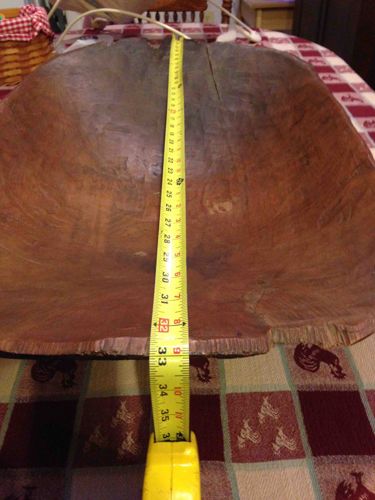
This is a large, antique hand-carved wooden trencher dough bowl, likely made from a single piece of hardwood, such as pine or poplar, given its age and common materials for such items. The bowl exhibits a rich, dark brown patina on its interior, suggesting significant use and age, with areas of lighter brown showing through where the surface might have worn or been cleaned over time. Its overall shape is elongated oval, typical of trencher bowls used for kneading dough or preparing food in early American or European households. A yellow measuring tape indicates a length of approximately 35.5 inches (nearly 3 feet), highlighting its substantial size which would have made it suitable for large-batch preparations. The interior surface shows distinct tool marks and irregularities from the hand-carving process, which contribute to its rustic charm and authenticity. There are visible cracks on the interior surface, particularly a prominent linear crack extending from one edge inward, indicating stress or natural aging of the wood. The edges of the bowl appear uneven and rough-hewn, further emphasizing its handmade origin. The exterior edges show a more raw, unfinished appearance, with some splintering and textural variations consistent with a hand-carved piece. The quality of craftsmanship, while rustic, is indicative of a utilitarian object made for daily use, prioritizing functionality and durability over fine aesthetics. The depth of the bowl appears shallow to medium, appropriate for kneading. Given the characteristics, it likely dates from the late 18th to the early 20th century, a period when such bowls were essential household items. Its large size and visible signs of age and handcrafted origin make it a compelling piece of folk art or primitive decor. No discernible maker's marks or signatures are visible in the provided image.
AI Appraisal Report
This antique hand-carved wooden trencher dough bowl, measuring approximately 35.5 inches in length, presents as a significant example of early American or European utilitarian folk art. My assessment, based on the provided image and description, indicates it is authentic and consistent with a late 18th to early 20th-century origin. The rich, dark brown patina on the interior, visible tool marks, and overall irregular, rough-hewn appearance strongly support its hand-carved, functional history. The elongated oval shape and substantial size are highly desirable characteristics for collectors of primitive kitchenalia.
Condition-wise, the bowl exhibits appropriate wear and aging for its presumed vintage. The visible linear crack extending from one edge inward, while an imperfection, contributes to its character and verifies its age through natural wood movement. The uneven edges and textural variations are expected and even celebrated in hand-carved pieces of this nature. This 'honest wear' is generally preferred over overly restored examples.
Market conditions for large, authentic trencher dough bowls remain strong. There is consistent demand from collectors of primitive antiques, farmhouse decor enthusiasts, and those seeking unique display pieces. Comparables for such sizable, well-patinated bowls range from $500 to over $1,200, depending on specific origin, material, and condition. The absence of restoration and the impressive length are significant value drivers.
Factors impacting value positively include its large size, visible hand-carving, and evident age. The crack, while present, does not severely diminish its value as it attests to its history. The primary limitation to a definitive authentication is the reliance on images alone. An in-person examination would allow for a tactile assessment of the wood species, a more precise evaluation of wear patterns, and a thorough inspection for any signs of modern alteration or repair masked by the patina. While no maker's marks are visible, provenance documentation, if available, could further enhance its value and historical context.