AI Appraisal Estimate

AI-generated estimates · not official valuations

From the user

What was submitted

Photo and notes provided by the user — not generated by AI

Submitted item photo
Submitted photo · June 6, 2026

User's notes

Mettlach Villeroy & Soch

AI analysis below

AI appraisal

AI analysis & estimate

AI-Generated · Verify before acting

Everything below is generated by AI for informational purposes only. AI can make mistakes — the AI may misidentify items or misattribute them (artist, maker, brand, designer, origin, era). This is not an official valuation and should not be used for insurance, sale, tax, estate, legal, or lending purposes — or any decision requiring a certified appraisal. It is not an authoritative claim about any person, brand, or rights holder — do not share or rely on it as a factual statement about a third party. Always consult qualified professionals before making financial decisions.

Note

This analysis also relies on unverified notes provided by the user, which may be incomplete or inaccurate and could affect the result.

Read the full disclaimer

AI Identification

·Not independently authenticated·Verify before acting

Mettlach Villeroy & Boch Stoneware Beer Stein, #2013

Antique Ceramics / German Breweriana

AI Estimated Value

·Not an official valuation·Verify before acting

$250 - $400

As of June 6, 2026

AI Item Analysis

·AI can make mistakes·Verify before acting
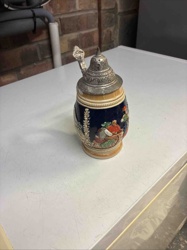
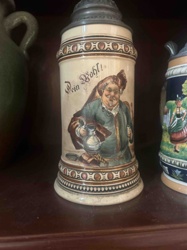
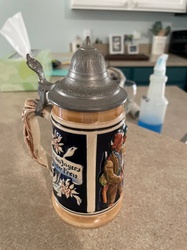
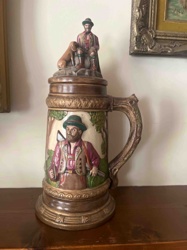
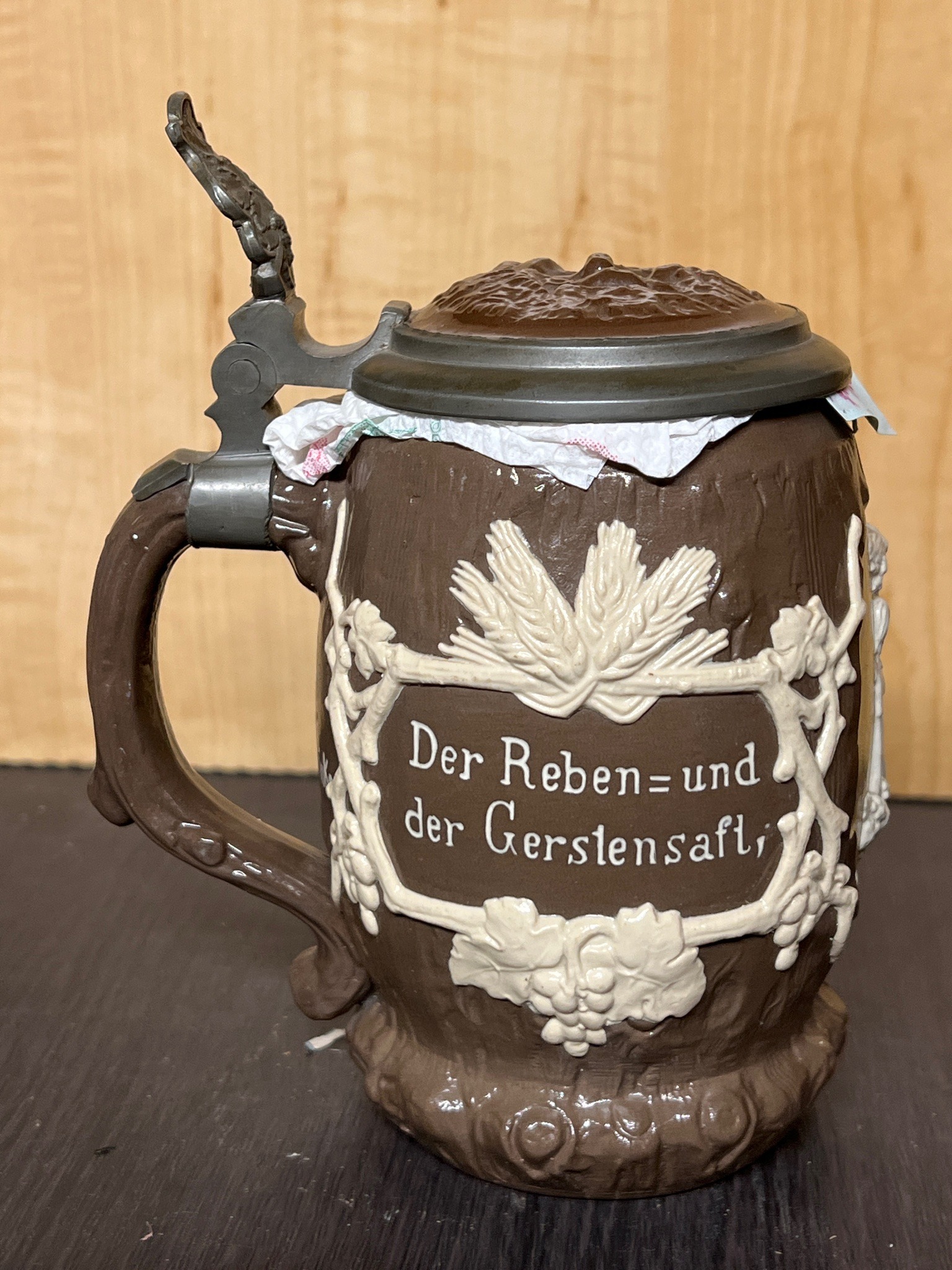
This is a Villeroy & Boch Mettlach stoneware beer stein (likely model number 2013), crafted during the late 19th or early 20th century. The body is characterized by a dark brown, textured 'tree bark' or rustic wood finish, achieved through specialized stoneware techniques. It features high-relief, white slip-cast (pâte-sur-pâte style) applications forming a central decorative cartouche. Inside the frame, the German gothic-style script reads, 'Der Reben- und der Gerstensaft,' which translates to 'The juice of the vine and the barley' (wine and beer). The frame is adorned with detailed wheat stalks at the top and grape clusters with leaves at the bottom, symbolizing the ingredients of the two beverages. The handle is modeled to resemble a gnarled wooden branch, consistent with the rustic 'Wald' (forest) aesthetic popular in this era. The piece is topped with a domed pewter lid featuring a textured ceramic insert that matches the dark brown body. The lid is attached via a sturdy pewter three-ring hinge and a detailed thumb lift. Construction shows the high quality synonymous with the Mettlach factory, though some modern paper residue is trapped beneath the lid's rim. The overall condition appears excellent with a rich patina on the pewter and crisp white highlights against the matte brown background; no significant chips or cracks are visible in the provided image.

AI Appraisal Report

·AI can make mistakes·Verify before acting
I have carefully examined the provided images of this Mettlach stoneware beer stein, identified as model number 2013, commonly referred to as the 'Barley and Vines' or 'Tree Bark' stein. This piece exhibits the classic etched and relief-molded characteristics synonymous with Villeroy & Boch’s late 19th-century production (circa 1895-1910). The execution of the white slip application against the dark, textured 'tree bark' ground is crisp, and the pewter lid assembly remains original and well-seated. The German inscription, 'Der Reben- und der Gerstensaft,' is a classic design choice that appeals strongly to collectors of German breweriana. From a visual standpoint, the condition appears Excellent. I observed no hairline fractures or chips, and the pewter maintains a desirable, soft patina. The inclusion of the ceramic insert in the lid adds significantly to its marketability, as these are often lost or replaced with plain pewter. While Mettlach steins are highly sought after, the current market for 'common' models like #2013 (which was mass-produced during the Golden Age of steins) has stabilized compared to the highs of the late 20th century. Please note that this assessment is based solely on digital imagery. For a definitive authentication, I would need to physically inspect the base for the 'Abtei' (abbey) castle mark and the date code (typically represented by two digits such as '98' or '04'). Specifically, I would check for internal hairline cracks not visible in photos and examine the hinge for potential solder repairs. While I am reasonably confident in its authenticity based on the quality of the relief work, provenance documentation or an in-person handle-to-lid stability test would be required for a certified insurance valuation.

Get your items appraised

Instant estimates of your treasures with AI-powered appraisals

Browse More Appraisals