AI Appraisal Estimate

AI-generated estimates · not official valuations

From the user

What was submitted

Photo and notes provided by the user — not generated by AI

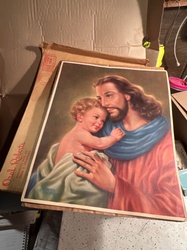
Submitted item photo
Submitted photo · June 6, 2026

User's notes

Unknown artist, unspecified, artwork artwork is framed size 2155 x 2685

AI analysis below

AI appraisal

AI analysis & estimate

AI-Generated · Verify before acting

Everything below is generated by AI for informational purposes only. AI can make mistakes — the AI may misidentify items or misattribute them (artist, maker, brand, designer, origin, era). This is not an official valuation and should not be used for insurance, sale, tax, estate, legal, or lending purposes — or any decision requiring a certified appraisal. It is not an authoritative claim about any person, brand, or rights holder — do not share or rely on it as a factual statement about a third party. Always consult qualified professionals before making financial decisions.

Note

This analysis also relies on unverified notes provided by the user, which may be incomplete or inaccurate and could affect the result.

Read the full disclaimer

AI Identification

·Not independently authenticated·Verify before acting

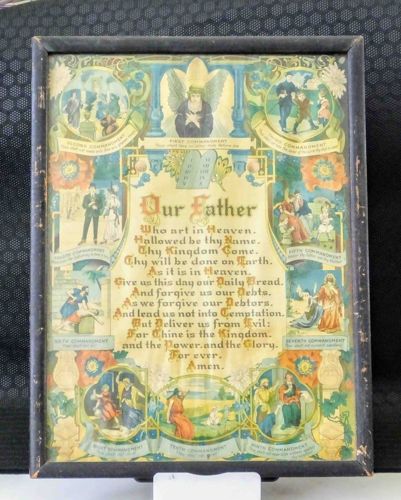
Victorian Religious Chromolithograph 'The Lord's Prayer and Ten Commandments'

Religious Art / Prints

AI Estimated Value

·Not an official valuation·Verify before acting

$125 - $225

As of June 6, 2026

AI Item Analysis

·AI can make mistakes·Verify before acting
This item is a late Victorian religious chromolithograph presented in its original dark wood frame. The central text features the full 'Our Father' prayer rendered in a stylized Gothic font with orange and black ink. Surrounding the central prayer are illustrative vignettes depicting scenes related to each of the Ten Commandments. The print utilizes a vibrant palette of blues, greens, burnt oranges, and yellows characteristic of turn-of-the-century mass-produced religious art. Notable decorative elements include neo-Gothic arch structures, floral motifs, and a central top image of an angel with the stone tablets of the law. The overall dimensions of the framed piece are 2155 x 2685 units. The condition shows visible signs of aging appropriate for a late 19th-century or early 20th-century piece; the frame exhibits significant chipping, surface loss, and wear along the edges, revealing the natural wood beneath the dark finish. There appears to be some foxing, yellowing, and minor corner chipping on the paper substrate itself, likely due to acidic contact with original backing materials. The craftsmanship is typical of the commercial lithography of the period, aimed at the domestic devotional market. Despite the wear, the imagery remains legible and intact, retaining its historical and decorative character.
AI Appraisal Report

·AI can make mistakes·Verify before acting
Based on my examination of this late Victorian religious chromolithograph, I have assessed its value within the current market for domestic devotional ephemera. The piece is a classic example of mass-produced lithography from the turn of the 20th century, likely dating between 1890 and 1910. The use of Gothic typography and illustrative vignettes for the Ten Commandments was a popular motif for the Protestant middle-market during this era. Condition is a primary factor here. While the vibrancy of the chromolithography remains surprisingly intact, the visible foxing and yellowing of the paper substrate—likely caused by acid migration from the original wood pulp backing—moderates the value. The significant chipping and loss of finish on the frame detracts from the aesthetic appeal, though it confirms the age and 'original' state of the presentation. The market for these specific prints is currently steady but niche. They are valued more as decorative antiques and historical artifacts of Victorian social history rather than as fine art. Rarity is low, as thousands were produced by commercial lithographers like Currier & Ives or similar European firms for the global market. Limitations and Authentication: My assessment is based solely on the provided visual data. To fully verify authenticity and refine this valuation, an in-person examination is required to check for dot patterns under magnification to confirm the printing process (lithography vs. modern reproduction). I would also need to examine the paper for a watermark and inspect the back of the frame to check for original labels. Without a physical inspection or provenance documentation, I cannot definitively rule out mid-20th-century reproductions that mimic this style.

Get your items appraised

Instant estimates of your treasures with AI-powered appraisals

Browse More Appraisals