AI estimate as of October 5, 2025 · verify with a professional before acting
AI-Generated · Verify before acting
Everything on this page is generated by AI for informational purposes only. AI can make mistakes — the AI may misidentify items or misattribute them (artist, maker, brand, designer, origin, era). This is not an official valuation and should not be used for insurance, sale, tax, estate, legal, or lending purposes — or any decision requiring a certified appraisal. It is not an authoritative claim about any person, brand, or rights holder — do not share or rely on it as a factual statement about a third party. Always consult qualified professionals before making financial decisions.
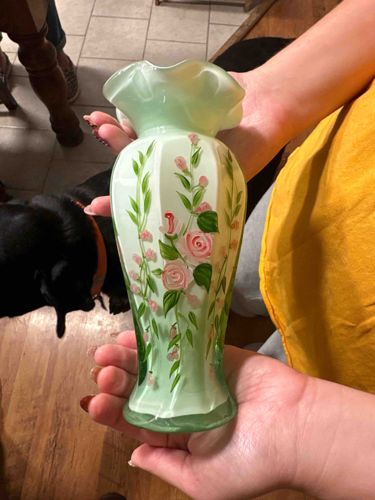
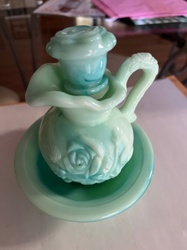
This is a decorative glass vase featuring a hand-painted floral motif. The vase is crafted from opalescent or milk glass, exhibiting a soft, pale mint green color that transitions to a yellower hue at the ruffled rim. The body of the vase is bell-shaped, tapering slightly towards a flared base, and stands approximately 6-8 inches tall, judging by its proportion in the hand. A distinctive feature is the ruffled or crimped rim, which adds an elegant and delicate touch to the overall design. The painted decoration consists of climbing rose bushes with pink blossoms, small pink rosebuds, and vibrant green leaves and stems, all rendered with a somewhat stylized, folk-art aesthetic. The painting appears to be applied directly to the exterior surface of the glass. The glass itself has a somewhat translucent quality, allowing for a subtle play of light that enhances its opalescence. There are no readily visible maker's marks or signatures in the provided images. The condition appears to be relatively good with no obvious chips or cracks visible, though potential wear to the painted surface or minor scratches to the glass cannot be entirely ruled out without closer inspection. The style suggests it could be a mid-20th century piece, possibly from the 1940s to 1960s, a period known for collectible opalescent and hand-painted glass wares. The craftsmanship indicates a production piece, but with individual hand-finished decorative elements, typical of decorative art glass from that era. The lack of significant visible wear on the painted details suggests it has been well-preserved.
AI Appraisal Report
Upon visual examination of the provided image, this hand-painted opalescent glass vase presents in good overall condition. I observe no apparent chips, cracks, or significant abrasions on the glass body. The hand-painted rose motif, while exhibiting a folk-art aesthetic, appears largely intact with no obvious major paint loss, suggesting it has been well-preserved. Authentication of the piece's age, likely mid-20th century (1940s-1960s), is based on stylistic characteristics common to opalescent and milk glass decorative items from that era. The ruffled rim and bell shape further support this period attribution. However, without a physical examination, I cannot definitively confirm the absence of minute scratches, hairline cracks, or subtle paint wear. The lack of visible maker's marks or signatures limits the ability to attribute it to a specific manufacturer without provenance documentation or a hands-on inspection for hidden marks.
In terms of market conditions, hand-painted opalescent or milk glass vases of this type are generally considered collectible but not exceedingly rare. Demand is moderate, primarily from collectors of vintage decorative glass or those seeking accent pieces for period decor. Comparable sales of similar hand-painted opalescent or milk glass items, often from unidentified manufacturers, typically fall within the $30-$100 range, with higher values for pieces by known glasshouses or with more intricate artistry. The charm of the hand-painted roses adds aesthetic appeal, but it doesn't elevate the piece into a high-value collectible category due to its commonality.
Factors significantly impacting value here include the good condition of both the glass and the paintwork. Any damage, such as chips, cracks, or substantial paint loss, would significantly diminish its market desirability and value. Conversely, the discovery of a desirable maker's mark would enhance its value. For full authentication and to rule out any restoration, a close in-person inspection of the glass for subtle imperfections, an examination for mold lines, and careful scrutiny of the paint application quality would be necessary. Provenance, if available, would also be beneficial.