AI estimate as of July 3, 2025 · verify with a professional before acting
AI-Generated · Verify before acting
Everything on this page is generated by AI for informational purposes only. AI can make mistakes — the AI may misidentify items or misattribute them (artist, maker, brand, designer, origin, era). This is not an official valuation and should not be used for insurance, sale, tax, estate, legal, or lending purposes — or any decision requiring a certified appraisal. It is not an authoritative claim about any person, brand, or rights holder — do not share or rely on it as a factual statement about a third party. Always consult qualified professionals before making financial decisions.
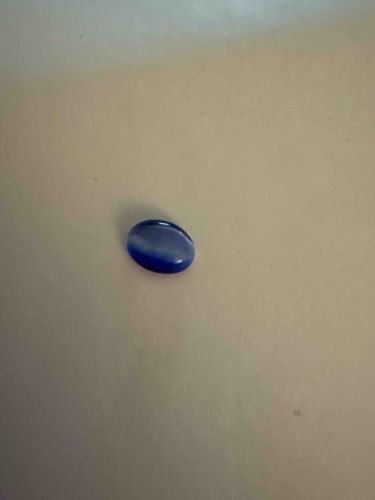
The item appears to be an oval, cabochon-cut gemstone, exhibiting a distinct blue color with a prominent chatoyancy effect, often referred to as a 'cat's eye' due to the bright, narrow band of light that runs across its surface. This phenomenon suggests the presence of very fine, parallel fibrous inclusions within the stone. The blue hue is deep and fairly saturated. Size-wise, it appears to be relatively small, likely suitable for inclusion in jewelry such as a ring, pendant, or earring. The surface seems polished and smooth, indicating good craftsmanship in its cutting. No discernible chips, cracks, or significant abrasions are visible from the provided image, suggesting it is in good to excellent condition. The lack of a setting implies it is a loose stone. Without further information, it's difficult to determine the exact material, but common gemstones displaying this effect include Chrysoberyl (the classic cat's eye), Tourmaline, Apatite, or various Quartz varieties. The specific shade of blue might also hint towards a synthetic material like lab-grown sapphire or glass, but the chatoyancy looks quite natural. There are no visible maker's marks or signatures as it is a loose gemstone. Its age and specific origin are impossible to ascertain from the image alone, but the cut and polish suggest a modern or contemporary piece of lapidary work. The quality indicator is the strong, well-defined chatoyancy, which is a desirable feature for such stones.
AI Appraisal Report
Upon visual examination of the provided image, I observe an oval, cabochon-cut gemstone displaying a striking blue hue and a highly desirable cat's eye effect. The chatoyancy appears strong and well-defined, suggesting excellent internal structure for this phenomenon. The polish on the cabochon seems smooth and unblemished, indicating good craftsmanship and overall good to excellent condition. No chips, cracks, or significant abrasions are visible, which is positive for its value.
From the image alone, definitive identification of the gemstone material is not possible. True chrysoberyl cat's eye is the most valuable, but this blue color often points to other chatoyant materials like tourmaline, apatite, moonstone, or even lab-grown sapphire or glass. The quality of the chatoyancy, however, looks natural. Without knowing the precise material, market comparables are broad. For a natural, high-quality blue chatoyant gem of unknown origin and species, demand exists but is not exceptionally high compared to more sought-after faceted gems. Rarity depends entirely on the material; common quartz-cat's eye would be low value, while a rare chatoyant tourmaline or apatite could be higher.
Factors significantly impacting value are primarily the material identification (natural vs. synthetic, specific gem species), the stability and intensity of the color, and the sharpness of the chatoyancy. The current market shows a steady demand for unique, high-quality loose gemstones, but without material certainty, the value is significantly limited. For full authentication and accurate appraisal, an in-person examination is crucial. This would allow for specific gravity testing, refractive index measurements, and spectroscopic analysis to identify the material. Provenance documentation, if available, could also shed light on its origin and history, further influencing its value.