These notes were written by the person who submitted this item. Appraiser.AI has not verified them, and the AI's identification and estimate may rely on them.
AI Estimated Value
Not an official valuation
$4,500-$7,500
AI estimate as of September 26, 2025 · verify with a professional before acting
AI-Generated · Verify before acting
Everything on this page is generated by AI for informational purposes only. AI can make mistakes — the AI may misidentify items or misattribute them (artist, maker, brand, designer, origin, era). This is not an official valuation and should not be used for insurance, sale, tax, estate, legal, or lending purposes — or any decision requiring a certified appraisal. It is not an authoritative claim about any person, brand, or rights holder — do not share or rely on it as a factual statement about a third party. Always consult qualified professionals before making financial decisions.
This analysis also relies on unverified notes provided by the user, which may be incomplete or inaccurate and could affect the result.
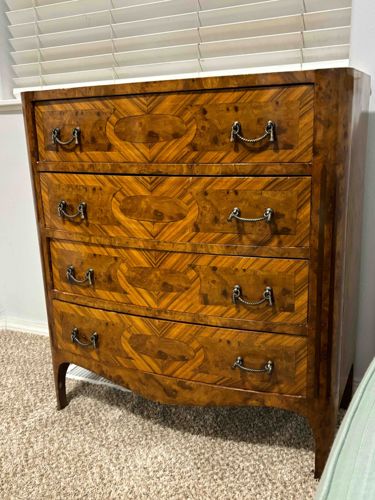
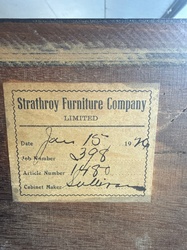
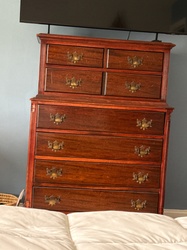
This is an antique bombe commode or chest of drawers, featuring a characteristically curvilinear bombe shape, particularly noticeable in the swelling sides and front. The piece is constructed with what appears to be a veneered surface, employing rich, warm-toned burl wood (possibly walnut or olive burl) with distinctive intricate grain patterns. The primary aesthetic detail is the elaborate marquetry, which forms geometric patterns, including chevron or herringbone diagonals and ovoid or cartouche-like shapes, framing the center of each drawer. This inlay work creates a highly decorative and visually engaging facade. The commode features four drawers, each fitted with ornate, possibly brass or bronze, drop pull handles that appear to be in the rococo or neoclassical style, connected by a decorative link or chain. The top surface of the commode is finished with what appears to be a light-colored, possibly white or cream, marble slab, adding a touch of elegance and durability. The legs are integrated into the bombe form, sweeping gracefully outwards at the bottom, typical of the style. Visible condition issues are minimal from the provided image, but some minor surface wear consistent with age, such as slight scratching or fading to the finish, might be present upon closer inspection. The overall patina suggests an item of considerable age, likely late 18th to mid-19th century, embodying a period style such as Rococo, Neoclassical, or transitional. The craftsmanship is high, evidenced by the detailed marquetry and the classic cabinetry construction. There are no visible maker's marks or signatures in the provided images.
AI Appraisal Report
Upon examining the antique bombe commode, I note its elegant curvilinear form and substantial construction, indicative of high-quality 18th or 19th-century European craftsmanship. The use of warm-toned burl wood veneer, likely walnut or olive, is particularly attractive, showcasing intricate grain patterns. The standout feature is the elaborate marquetry, forming sophisticated geometric patterns, including chevron and cartouche designs, which significantly enhance its decorative appeal. The four drawers are fitted with ornate brass or bronze drop pull handles, consistent with Rococo or Neoclassical styles, which complement the commode's overall aesthetic. The light-colored marble top adds a touch of luxury and durability, further elevating its value.
From the image, the condition appears excellent for its age, with only minor surface wear expected. The patina suggests authenticity, and the integrated, gracefully sweeping legs are typical of the period. The absence of visible major damage or significant repairs is a plus.
In terms of market conditions, bombe commodes with high-quality marquetry and marble tops are consistently sought after by collectors and interior designers, especially those with refined detailing like this piece. Demand for well-preserved, aesthetically pleasing antique furniture remains stable. Comparables would include similar French or Italian commodes from the Louis XV, Transitional, or early Neoclassical periods, often fetching prices in the multi-thousand dollar range depending on condition, complexity of marquetry, and provenance.
Factors significantly impacting value include the exceptional marquetry work, the luxurious materials (burl wood and marble), and the overall condition. The lack of visible signs of major restorations also contributes positively.
However, it's crucial to acknowledge the limitations of an appraisal based solely on images. Full authentication requires an in-person examination to ascertain the exact wood species, examine construction techniques (e.g., drawer joinery, internal bracing), verify the authenticity and age of the marquetry and hardware, and thoroughly assess any hidden repairs or restorations. Provenance documentation, if available, would provide invaluable historical context and further solidify its value. Further scientific testing of materials could also definitively confirm dating and originality.